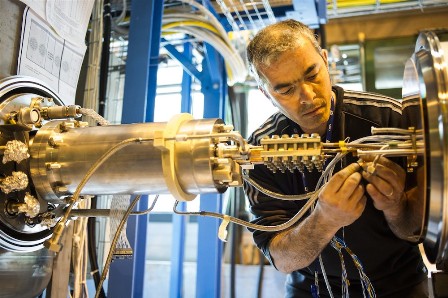


PARIS: In March, when researchers flip the switch to the world’s largest, most powerful particle accelerator, scientists from all over the world will be watching. Physicists expect the refurbished, higher-energy Large Hadron Collider (LHC) will build on the 2012 discovery of the Higgs particle and crack open even more mysteries of the universe.
Last week, Berkeley Lab researchers, Beate Heinemann and Peter Jacobs were on a panel of scientists that discussed the scientific implications of this new and improved accelerator. At the annual meeting of American Association for the Advancement of Science in San Jose, the researchers summarized their expectations.
Overall, the consensus among the panelists: the LHC’s second run will produce more data to refine the Standard Model — the theory that describes subatomic particles and the forces that dictate their behavior. This refinement is needed, said Heinemann, because there are still fundamental physics questions the Standard Model can’t address.
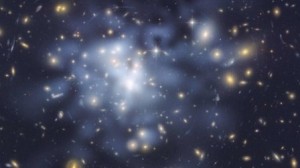
Questions remain about gravity (Why is it so weak?); antimatter (Why is there so little of it?); and dark matter, the mysterious and invisible substance that makes up nearly a quarter of the universe (What particle might be responsible?).
The LHC first came on line in 2010, costing nearly $12 billion and taking more than a decade to build. Between 2010 and early 2013, it operated nearly continuously at lower energy than it was designed to run at, up to 8 trillion electron volts. By the summer of 2012, news broke that two LHC experiments called ATLAS and CMS had found evidence for the Higgs boson, a particle theorized to give other particles their mass. A year later, theoretical physicists Peter Higgs and Francois Englert, who predicted the particle, won the Nobel Prize in physics.

Karachi Port sets 138-year cargo handling record
KARACHI: Pakistan's maritime sector has achieved a major milestone as Karachi Port set a new record in its 138-year history...