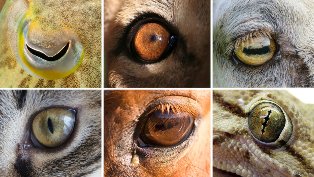


HONG KONG: There’s a reason why the domestic cat’s pupil has its distinctive, vertical slitted shape and the grazing goat’s its horizontal, flattened look. In both cases, the eye’s shape has evolved to help its owner navigate everyday life. The cat needs to be able to hunt at night with precision; the grazing goat, to detect predators and flee, if need be.
So concluded a team of scientists at UC Berkeley and the University of Durham in England when they analyzed the eyes of 214 terrestrial species, hoping to answer a deceptively simple question about creepers’ peepers: Why do animals’ eyes have pupils of different shapes?
The question occurred to UC Berkeley vision scientist Martin Banks almost by accident, he said, as an outgrowth of earlier work in human vision and perception that looked at the relationship between stereoscopic vision — the brain’s ability to combine images from the right and left eye — and blur, and how the human vision system uses both to estimate distances.
As part of that research, Banks and students had written briefly about “odd-shaped pupils” in the animal kingdom — specifically, the vertical slits in the eyes of domestic cats and other small ambush predators, which help those animals pick up on the same distance cues (stereopsis and blur) to gauge how far they must pounce to capture would-be prey.

Karachi Port sets 138-year cargo handling record
KARACHI: Pakistan's maritime sector has achieved a major milestone as Karachi Port set a new record in its 138-year history...