Customs Today
  • Home
  • Islamabad
  • Karachi
  • Lahore
  • National
  • Transfers and Postings
  • Chambers & Associations
  • Business
No Result
View All Result
Customs Today
  • Home
  • Islamabad
  • Karachi
  • Lahore
  • National
  • Transfers and Postings
  • Chambers & Associations
  • Business
No Result
View All Result
Customs Today
No Result
View All Result
Home Science & Technology Science

Why Comets are like deep fried ice cream, NASA researchers discovered

byCustoms Today Report
14/02/2015
in Science, Science & Technology
Share on FacebookShare on Twitter

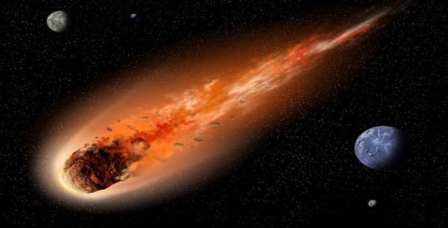
NEW DELHI: NASA researchers may have discovered why comets are encased in a hard, outer crust like ice cream that has been deep fried. Using an icebox-like instrument nicknamed Himalaya, they showed that fluffy ice on the surface of a comet would crystalize and harden as the comet heads toward the sun and warms up.

“A comet is like deep fried ice cream,” said Murthy Gudipati of Nasa’s Jet Propulsion Laboratory, corresponding author of a recent study appearing in The Journal of Physical Chemistry.


You might also like

Tesla driverless system to use updated radar technology

12/09/2016

Apple to develop its own self-driving technology

10/09/2016

“The crust is made of crystalline ice, while the interior is colder and more porous. The organics are like a final layer of chocolate on top.”

The lead author of the study is Antti Lignell, a postdoctoral scholar at the California Institute of Technology in Pasadena, who formerly worked with Gudipati at JPL.

Researchers already knew that comets have soft interiors and seemingly hard crusts. Last November, Rosetta’s Philae probe bounced to a landing on the surface of 67P/Churyumov-Gerasimenko, confirming that comets have a hard surface. But the exact composition of comet crust, and how it forms, was unclear.

In the new study, researchers turned to labs on Earth to put together a model of crystallizing comet crust. The experiments began with amorphous, or porous, ice — the proposed composition of the chilliest of comets and icy moons. At these extremely cold temperatures of around minus 243 degrees Celsius (minus 405 degrees Fahrenheit) water vapor molecules are flash-frozen and haphazardly mixed with other molecules, such as the organics. Amorphous ice is like cotton candy, explains Gudipati: light and fluffy and filled with pockets of space.


Tags: Why Comets

Related Stories

Tesla driverless system to use updated radar technology

byCT Report
12/09/2016

WASHINGTON: Electric carmaker Tesla announced Sunday it was upgrading its Autopilot software to use more advanced radar technology. In a...

Apple to develop its own self-driving technology

byCT Report
10/09/2016

SAN FRANCISCO: Apple may not become an automaker, but it still wants to develop its own self-driving technology. The iPhone-maker's...

NASA spots slowest known magnetar

byCT Report
10/09/2016

WASHINGTON: Astronomers have found evidence of a magnetar - magnetised neutron star - that spins much slower than the slowest...

‘YouTubers’ outshining old-school television

byCT Report
09/08/2016

SAN FRANCISCO: A media revolution is taking place, and most people over 35 years of age aren’t tuned in. Millennial...

Next Post

Google planes to introduce balloon-powered internet and kite-powered energy to India

  • Terms and Conditions
  • Disclaimer

© 2011 Customs Today -World's first newspaper on customs. Customs Today.

No Result
View All Result
  • Transfers and Postings
  • Latest News
  • Karachi
  • Islamabad
  • Lahore
  • National
  • Chambers & Associations
  • Business
  • About Us

© 2011 Customs Today -World's first newspaper on customs. Customs Today.