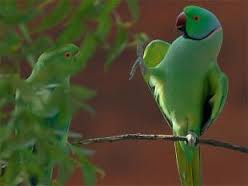


Ever wondered why parrots are such good imitators of human speech? Well, an Indian-origin scientist has found the answer. According to researchers, parrots have structurally different brain when compared other animals which gives parrot the ability to imitate human speech.
Lead study author Mukta Chakraborty, a post-doctoral researcher in the lab of Erich Jarvis, an associate professor of neurobiology at Duke University and a Howard Hughes Medical Institute Investigator, analysed the gene expression patterns and found that parrots have coating or outer rings called ‘shells’ over the centres known as cores in the brain which contribute to vocal learning. In the case of parrots, these ‘shells’ also contribute to vocal learning thus, giving parrots unparalleled ability of speech imitation.
Although scientists have been studying parrots’ brain to unravel the mystery of their talking ability for past 34 years but none figured out that these unique creatures have different brain structure. Some other birds including hummingbirds and songbirds also exhibit vocal learning but unmatched to parrots’ ability.
Chakraborty further explained that for the study his team examined eight parrot species including budgerigar, conures, cockatiels, lovebirds, two species of Amazon parrots, a blue and gold macaw, a kea and an African Grey parrot. Researchers observed specific gene markers that are known to stimulate specific regions of brains in humans as well as in song learning birds and then compared it to parrots’ brain. The study authors found that even the oldest parrot species — the Kea of New Zealand had shells around cores in the brain. This suggests that the talking ability of parrots might be nearly 29 million years old.

Karachi Port sets 138-year cargo handling record
KARACHI: Pakistan's maritime sector has achieved a major milestone as Karachi Port set a new record in its 138-year history...