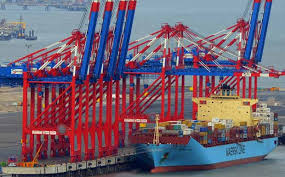
WILHELMSHAVEN: The first years proved a difficult start for Germany’s only deep water port, Wilhelmshaven’s Jade-Weser-Port container hub, inaugurated in 2012, but its operators are now seeking to make it a top terminal for supersize ships.
The head of the Eurogate container terminal on Germany’s North Sea coast, Mikkel Andersen, smiles as he watches the busy comings and goings down on the quay from up high in his office. Among the vessels docked below is a ship with a carrying capacity of 6,000 TEU or “Twenty-foot equivalent unit” — the unit of measure in the sector.


That is still a featherweight compared to the supersize ships of 15,000 TEU or more that the port was built for. Yet despite already ranking as Germany’s largest naval base and the largest import terminal for crude oil, Wilhelmshaven — situated around 100 kilometres (60 miles) from Bremen — hopes the Jade-Weser-Port Container Terminal will catapult it into the world’s premier league.
With the nearby ports of Hamburg and Bremerhaven unable to handle the new supersize ships, Wilhelmshaven is seeking to give Rotterdam and Antwerp a run for their money, and become the main stopping point in Europe for giant container vessels arriving from Asia.
“The boats are getting ever larger, longer and higher” as shipping companies seek economies of scale, says Soenke Maatsch from the Institute of Shipping Economics and Logistics (ISL) in Bremen.
Few ports around the world are able to handle the new giant container ships, sometimes measuring up to 400 metres (1,300 feet) in length, or have the necessary sea depth for them to dock.