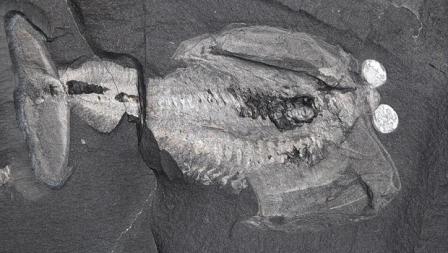
LEEDS: Some of the world’s oldest fossilized brains are helping shed light on how heads evolved in early animals.
The specimens were first discovered in Western Canada’s Burgess Shale – a rich source of fossils – and are believed to be more than 500 million years old. They’ve been in the collection of a Toronto museum and the Smithsonian Institution in Washington.
You might also like


In a new study, scientists at the University of Cambridge used the fossils to identify a key point in the evolutionary transition from soft to hard bodies in the early ancestors of arthropods, the group of creatures that contains modern insects, crustaceans and spiders.
“Heads have become more complex over time,” Jsaid avier Ortega-Hernández, a postdoctoral researcher from Cambridge’s Department of Earth Sciences, who authored a study on the brains published in Current Biology. “But what we’re seeing here is an answer to the question of how arthropods changed their bodies from soft to hard. It gives us an improved understanding of the origins and complex evolutionary history of this highly successful group.”