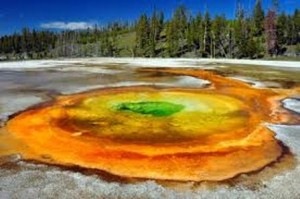


HONG KONG: Yellowstone National Park’s bowels are at least 9,000 kilometers deep.Although this may seem like an odd statistic, one of UNM’s assistant professors, who is working in conjunction with the University of Utah, said it was partially to be expected.
The findings were published online last Thursday in the journal Science. The publication gives readers a view of the deep crust volume where melts from the mantle are processed.
The rocks that are found in and around Yellowstone didn’t seem to match the information understood previously, said assistant Earth and Planetary Sciences professor Brandon Schmandt.
“If your starting point is melting the mantle, the question is, ‘how do we get these silica-rich rhyolites to be the major constituent of large-volume eruptions at Yellowstone?’” he said. “There has to be some kind of staging or mixing area in the deep crust, the lower crust to make those rhyolites.”
The group used seismic waves to scope out an image of the mantel below the caldera, he said. While there aren’t enough data elsewhere to compare the magnitude of the Yellowstone chamber to other places, it is still a starting point for future projects
“It’s a difficult depth range to image; we are better at working shallower than deeper,” Schmandt said. “This is sort of a tough part of Earth to image.”
Depending on the temperature of the area the seismic waves are traveling through, they will move faster or slower, he said.
The reservoir is similar to those seen near subduction zones, which are fueled by mantle melting, he said. It has a lot in common with continental arc volcanoes, which are volcanoes that form along tectonic plates near subduction zones.

Karachi Port sets 138-year cargo handling record
KARACHI: Pakistan's maritime sector has achieved a major milestone as Karachi Port set a new record in its 138-year history...