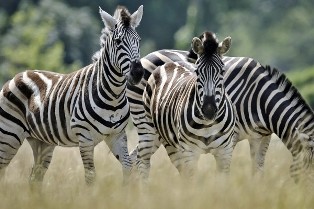
NEW YORK: A zebra’s stripes are unlikely to protect it from pursuing predators, contrary to the view of most experts, research has shown.
Humans playing the part of predators in a computerised chase game showed they could “capture” striped targets more easily than those coloured a uniform grey.


The result reopens the debate about the function of zebra stripes.
It had been thought that the stripes evolved to “dazzle” predators trying to keep track of animals moving in a group.
A similar “motion dazzle” principle was adopted in the two World Wars, when flotillas of ships were camouflaged using geometric shapes in contrasting colours.
Rather than concealing the ships, the idea was to make it more difficult for an enemy to estimate a target’s range, speed and heading.
“We found that, when targets are presented individually, horizontally striped targets are more easily captured than targets with vertical or diagonal stripes,” study leader Anna Hughes, from Cambridge University, said.
“Surprisingly, we also found no benefit of stripes when multiple targets were presented at once, despite the prediction that stripes should be particularly effective in a group scenario. This could be due to how different stripe orientations interact with motion perception.”
Sixty volunteers took part in the research, performing a touch-screen task in which they attempted to “catch” moving targets.