LAHORE: The prime minister’s announcement of financial package for the farmers will not help rice and cotton growers as the prices of both the commodities are decreasing by 13 per cent on yearly basis, said experts.
They said that cash support of Rs5000 per acre for small farmers would meet 68% of loss for rice farmers and just 29% for cotton growers, while a price decline of 28% for cotton and 22% for rice would be seen in 2016.


The experts expressed these views in a report released by the Institute for Policy Reforms. They said that Rs20 billion rupees provided for rice and cotton each would fall short by 34% and 30% respectively taking into account the number of small farmers and the acreage.
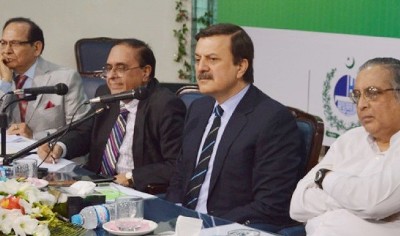
Dr Hafiz Pasha, the Managing Director IPR, in his report titled ‘An Evaluation of the Prime Minister’s Agriculture Relief Package’ welcomed the Prime Minister’s relief package for farmers, which was announced at a time of falling output prices.
He said that the package attempted to extend essential support to agriculture, however, evaluation of the package raises issues about the timing and adequacy of cash support, as well as its mechanism. Questions remain also about the measures to reduce input cost and to provide access to credit, he added.
The cost of Prime Minister’s relief package for farmers could increase fiscal deficit by an estimated 0.4 percent of the GDP, however, the cash support and access to credit would have positive effect on small farmers while other measures may help medium and large farmers.
The report also recommended a number of additional measures to increase effectiveness of the package and lack of consultation with provincial governments.
The report expresses fear that “Once again good intentions may fail to convert to sound deeds and leave the feeling of unilateral policymaking. This is hardly advisable for strengthening the Federation.”
Targeting of benefits would be a challenge. It requires estimating cropping patterns at individual farm level. This could lead to leakage during disbursement and government must do all to prevent it from happening.
With fertilizer comprising 35% of farm variable input cost, government is right to target reduction in its price. The estimated 15% reduction in price of potassium and phosphate also has the potential to improve the country’s fertilizer mix.
Some questions remain, especially with respect to effect on fiscal operations. The burden of cost to be borne by each province is not clear. The package does not quantify the fiscal effect of withdrawal of price increase on Urea. If the reduction comes through reduced GST, the revenue loss would be Rs 10 billion.
Similarly, estimate of Rs 7billion as the fiscal effect of tariff reduction seems incorrect. Its true impact is Rs.10 billion or 43% higher. Government estimates GST support by provinces to cost Rs 7 billion whereas it would cost Rs 11 billion, or 57% higher. Continued load-shedding will take away the real impact of reduction in tariff. Government also has overestimated the cost reduction by Rs500 per bag of fertilizer.
Through a number of measures, the package attempts to correct the bias in access to credit for agriculture. However, there are questions about its viability when farm profits are falling. ZTBL, the main supplier to small farmers, already has 20% non-performing loans.
It is uncertain if it is prudent for ZTBL to take on higher risk. Regardless, the announced measures would likely benefit small farmers. The package provides balanced relief to all farm sizes.
Cash support and credit targets small farmers while reduced costs help large and medium sized farms. The package seems to have underestimated by Rs31 billion its cost to the federal and provincial budgets.
Overall, it would increase the fiscal deficit by a half percent of GDP. This is entirely justified though may need special advocacy with the IMF. The report recommends that rather than reacting, government may look holistically at its policy in support of agriculture. Commodity prices would likely stay low for some time to come.
In addition to measures in force already, the report recommends support price for additional products. Of these, rice and cotton need early inclusion.
Government may provide export subsidy for rice to help dispose off present stock as well as stabilize domestic price. Government may reduce price of Light Diesel Oil, as 90% of all tube wells work on diesel.
IPR recommends reduction in GST on LDO from the present 29.5% to 7%. Largely, success of this relief package depends on commitment by provincial governments.