BEIJING: Most of China’s oil products trade is on short-haul routes with other countries in Asia, even if some longhaul volumes also play a role. However, there have been shifts in trends in China’s seaborne imports and exports of oil products in recent years. China has traditionally been a net importer of oil products, but today China’s imports are falling whilst its exports are on the rise.
Declining Imports


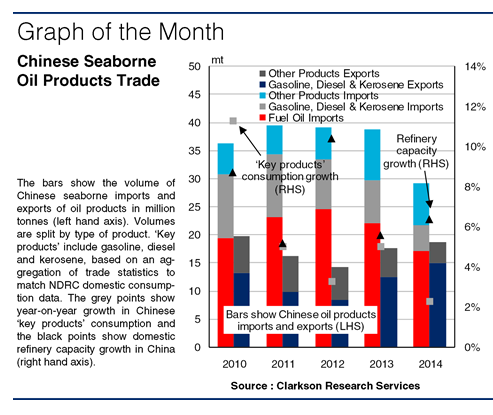
Following a period of firm growth in seaborne oil products imports into China prior to 2011, volumes fell slightly in 2012. Since then imports have continued to fall and in 2014 registered a 24% y-o-y decline to total 29.2mt. This was the lowest volume imported since 2004. This trend has continued into 2015, with imports in Q1 down 7% y-o-y, totalling 7.8mt.
Impact of Refinery Capacity
Gasoline, diesel and kerosene combined (defined here as ‘key products’) accounted for much of the decline in Chinese products imports. Imports of these products are mostly sourced from other Asian countries and in 2010-14, fell 20% p.a. to 4.7mt, partly reflecting increased capacity in the country’s oil refinery sector. At the end of 2014, China’s refinery capacity reportedly stood at around 670mtpa, having seen growth of almost 7% p.a. since 2010. In line with this expansion, refinery output of these products rose 26% in the period to 317mt. Growth in China’s ‘key products’ consumption also slowed, further contributing to the decline in imports. Imports of fuel oil have not fallen to the same extent, but softened by 3% p.a. in 2010-14 to 17.1mt, partly as some private refineries were refining more crude oil and less fuel oil. Most of the drop was accounted for by falling imports from Russia; imports from other major suppliers remained fairly steady.
Rising Exports
In contrast to imports, Chinese seaborne oil products exports have risen since 2012. Exports totalled 18.7mt in 2014, up from 14.3mt in 2012, and gasoline, diesel and kerosene combined account for the majority of shipments. Around 90% of China’s exports of these products are on short-haul intra-Asian routes. Growth in exports has largely been driven by domestic oversupply of products as a result of increased capacity in the refinery sector, as well as weaker domestic demand.
Emerging As A Net Exporter?
Robust growth in gasoline, diesel and kerosene exports has led China to emerge as a net exporter of these ‘key products’. Moreover, during some months in 2014, China was a net exporter of all products. Overall, however, shifts in trends in Chinese products imports and exports combined have led to a fall in China’s seaborne products trade from 56.0mt in 2010 to 47.9mt in 2014.
So, China’s role in oil products trade is changing, with falling volumes notable on short-haul import routes (the recent trade agreement between PetroChina and Venezuela may protect some long-haul trade, which could moderate the impact on vessel demand). Despite the clear upwards trend in Chinese exports, the declining import trend looks likely to be enough to lead total Chinese products trade to continue to drop in the short-term at least.
Source: Clarksons