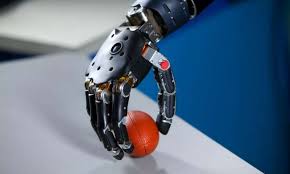
OVERIJSSEL: Robots carry out their tasks more safely if they are controlled by another technology. This makes them much more suitable for use in the care sector, as revealed by a study conducted at the Robotics and Mechatronics department at the University of Twente. On 2 June, researcher Stefan Groothuis is being awarded his PhD for this work.
In the coming years the use of assistive robotics, as they are known, will become ever more important due to the increased ageing of the population and the steadily rising costs of care. Already, robot technology is very valuable for people with a physical handicap when it comes to carrying out everyday tasks. A robot arm on a wheelchair or table, for instance, enables a person to open the door or pick up a glass by themselves, meaning that this group of patients is less dependent on health care workers and also increasing the patients’ quality of life.


However, in practice the existing form of robotics are not ideal for a care-support function because the systems are based on robots that carry out repetitive tasks in industry. These robots generally behave as rigid and less safe systems: the system that controls the electromotors (actuators) lacks the flexibility that is required in an unfamiliar domestic environment. The robot will often seek the shortest route from A to B, taking little or no account of obstacles or persons in its immediate surroundings. And so there is a relatively large risk of the robot or the obstacle being damaged.
Adding a kind of elastic spring to the actuator can make the robot, or the robot arm, much safer, as shown by research carried out by the Robotics and Mechatronics department. This spring ensures that the robot behaves in a more elastic way: it yields when it collides with an obstacle. This technology (known as the variable stiffness actuator) has never before been used in assistive robotics. “We believe this can form the basis of a new generation of robots in the care sector: robots that can carry out more everyday tasks in a safer way, while simultaneously remaining extremely precise,” says researcher Stefan Groothuis.
A further improvement to the robot arm has been achieved by positioning the actuator differently. Normally each joint has one electromotor, enabling this joint to move. In the human body this movement is achieved by the muscles around a joint, such as in the hip joint. But humans also have various muscles that move two joints simultaneously, such as the biceps, which moves the elbow and shoulder. This principle has been incorporated in the research and it provides the robot arm with other elastic properties. Groothuis’ doctoral research has resulted in different variable stiffness actuators and a mathematical model for robot arms based on a network structure. With the help of this model it becomes relatively easy to adjust the positioning of actuators, which simplifies the analysis of these arms. This makes it possible to develop a robot arm ideally suited for the health care sector.