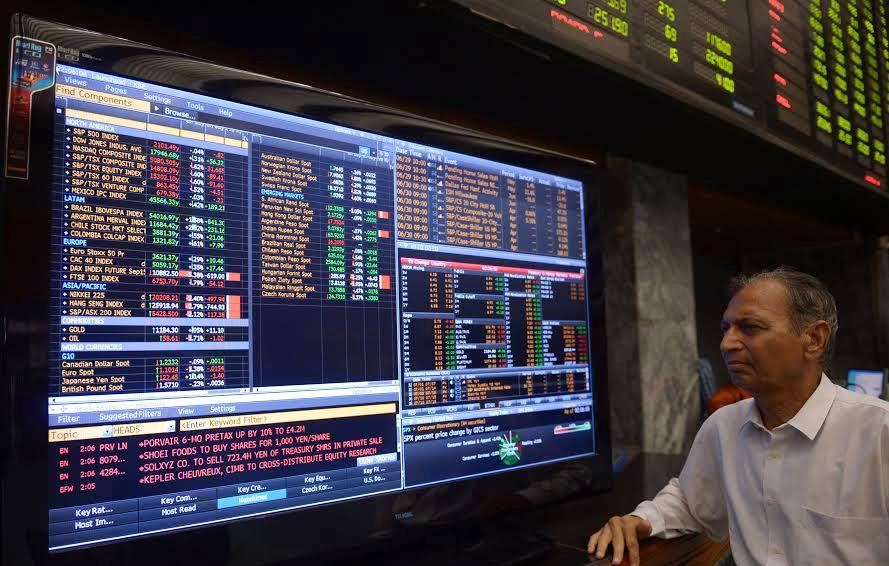
KARACHI: The Pakistan Stock Exchange (PSX) gained momentum in the outgoing week as investor participation was comparatively high amid presence of market moving triggers. The benchmark KSE-100 index by gaining 173.93 points (0.51 per cent) closed at 34,377.61 points.
Traders, initially, were in a state of uncertainty and a bit of nervousness on Friday as the JUI-F-led anti-government protest march moved towards Islamabad with politicians agitating the participating crowd.


But later, the market managed to calm down and the index bounced back as heavy buying erupted in the current favourites, cement, oil marketing companies and blue-chip stocks in selected sectors.
The volume decreased 14.6 per cent to 157.1m shares, from 184.0m while traded value declined 6pc to $41.5m, as against $44.1m.
In the previous week, the stock market remained lackluster following the formal announcement of the Financial Action Task Force (FATF) to keep Pakistan in the grey list till Feb 2020.
According to stock market analysts, simmering Pak-India tensions and the current uncertain political situation in the country, and FATF’s warning to Pakistan to fully comply with its recommendations for curbing terror financing and money laundering – all had contributed to the bearish trend in the market in the previous weeks.
The Paris-based watchdog had mentioned that Pakistan had largely complied with some of the 40 action items but expressed serious concerns with the overall lack of progress. It had cautioned the country to swiftly complete its full action plan by February 2020 to stave off the blacklist.
The Pakistani rupee in the outgoing week appreciated against the U.S. dollar with 23 paisa in the interbank and closed at Rs155.65 on Friday.
Likewise, in the open market, it gained its value by 25 paisa and closed at Rs155.75 against the greenback with slight fluctuation in the whole week.
Earlier, the World Bank Group had forecasted Pakistan’s economic growth to slow down for the next two years as it continues to face another macroeconomic crisis due to massive twin deficits and low foreign reserves.
Despite significant devaluation, the WB still sees the rupee overvalued by the end of September by approximately 4.8%.
In the last three months, the local currency was observed to significantly recover against the greenback in both interbank and open markets.
Analysts had expressed fear that the intense ongoing trade war between the United States and China would result in fluctuation of the U.S. dollar in the local market, and the value of the Pakistani rupee would stabilise depending on the measures taken by the government with appropriate economic policies.
Currency traders were of the view that the increasing inflows of remittance have supported the local rupee in the market.
Until June this year, the rupee was observed to cumulatively depreciate against the greenback, which in turn, had resulted in increased prices of goods and hardships for the general public.
The SBP has let the rupee depreciate significantly in the inter-bank market after finalising an agreement with the International Monetary Fund (IMF) for a loan programme on May 12.
The IMF asked Pakistan to end state control of the rupee and let the currency move freely to find its equilibrium against the US dollar.
On the other hand, the World Bank Group has also supported the idea of leaving the rupee free from state control in an attempt to give much-needed boost to exports and fix a faltering economy.
After the International Monetary Fund (IMF) lent the first tranche of $991.4 million to Pakistan, the local currency had depreciated massively.
The stringent conditions – on which the global moneylender has formally approved the bailout package of $6 billion for Pakistan – seemed to have exerted more pressure on the local currency.
The gradual drop in the rupee had come due to high demand for the dollar against thin supply as the country continued to make aggressive international payments to partially pay off huge foreign debt and for imports.
Economists were of the view that effective measures must be implemented on the priority basis to recover the state from the balance of payment deficit.
Besides increased demand of the greenback in the local market, they had termed ‘balance of payments deficit’ as the main reason in the recent hike in the value of the US dollar.
Moreover, they had considered that state’s exports and investment were required to grow significantly, and the imports must be reduced to remove pressure on the local currency.
According to experts, the government must ensure implementations on economic policies after the deal with the IMF.