Customs Today
  • Home
  • Islamabad
  • Karachi
  • Lahore
  • National
  • Transfers and Postings
  • Chambers & Associations
  • Business
No Result
View All Result
Customs Today
  • Home
  • Islamabad
  • Karachi
  • Lahore
  • National
  • Transfers and Postings
  • Chambers & Associations
  • Business
No Result
View All Result
Customs Today
No Result
View All Result
Home Science & Technology Science

Arctic ice cap slides 25 times faster into Polar Ocean

byCustoms Today Report
26/01/2015
in Science, Science & Technology
Share on FacebookShare on Twitter

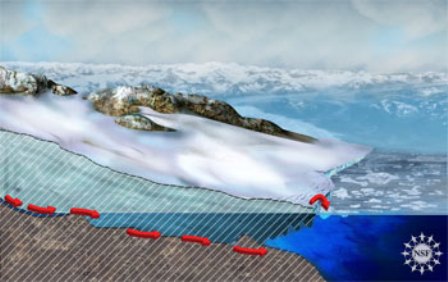
PARIS: According to a new study, a remote Arctic ice cap, in the face of warming temperatures and climate change, is now flowing 25 times faster into the ocean compared to 2012.

According to satellite images, the southeast region of Austfonna, located in the Svalbard archipelago, is thinning at an incredible rate. In fact, in the last three years alone the region has thinned by more than 50 meters (164 feet) – about one sixth of its original thickness.


You might also like

Tesla driverless system to use updated radar technology

12/09/2016

Apple to develop its own self-driving technology

10/09/2016

Consequentially, melting is now occurring within 10 kilometers (6.2 miles) of the summit.

“These results provide a clear example of just how quickly ice caps can evolve, and highlight the challenges associated with making projections of their future contribution to sea level rise,” study lead author Dr. Mal McMillan, a member of the Centre for Polar Observation and Modelling (CPOM) team from the University of Leeds, said in a statement.

Researchers reached their conclusions with help from eight satellite missions, including Sentinel-1A and CryoSat.

“New satellites, such as the Sentinel-1A and CryoSat missions, are essential for enabling us to systematically monitor ice caps and ice sheets, and to better understand these remote polar environments,” McMillan added.

It’s no secret that melting ice caps and glaciers, both in the Arctic and Antarctic, are major contributors to rising seas. They’re responsible for about a third of recent global sea level rise. But predicting how much ice loss will occur in the future is difficult, and therefore forecasting how high oceans will rise is also hazy.

“Feeding the results into existing ice flow models may help us to shed light on the cause, and also improve predictions of global ice loss and sea level rise in the future,” noted co-author Andrew Shepherd.


Tags: " McMillan added25 times faster into Polar OceanArctic ice capDr. Mal McMillansoutheast region of AustfonnaSvalbard archipelago

Related Stories

Tesla driverless system to use updated radar technology

byCT Report
12/09/2016

WASHINGTON: Electric carmaker Tesla announced Sunday it was upgrading its Autopilot software to use more advanced radar technology. In a...

Apple to develop its own self-driving technology

byCT Report
10/09/2016

SAN FRANCISCO: Apple may not become an automaker, but it still wants to develop its own self-driving technology. The iPhone-maker's...

NASA spots slowest known magnetar

byCT Report
10/09/2016

WASHINGTON: Astronomers have found evidence of a magnetar - magnetised neutron star - that spins much slower than the slowest...

‘YouTubers’ outshining old-school television

byCT Report
09/08/2016

SAN FRANCISCO: A media revolution is taking place, and most people over 35 years of age aren’t tuned in. Millennial...

Next Post

Arctic ice cap’s stunningly fast skate into the sea

  • Terms and Conditions
  • Disclaimer

© 2011 Customs Today -World's first newspaper on customs. Customs Today.

No Result
View All Result
  • Transfers and Postings
  • Latest News
  • Karachi
  • Islamabad
  • Lahore
  • National
  • Chambers & Associations
  • Business
  • About Us

© 2011 Customs Today -World's first newspaper on customs. Customs Today.