

Customs Today
  • Home
  • Islamabad
  • Karachi
  • Lahore
  • National
  • Transfers and Postings
  • Chambers & Associations
  • Business
No Result
View All Result
Customs Today
  • Home
  • Islamabad
  • Karachi
  • Lahore
  • National
  • Transfers and Postings
  • Chambers & Associations
  • Business
No Result
View All Result
Customs Today
No Result
View All Result
Home Science & Technology Science

Astronomers discovered most distant object in our solar system

byCustoms Today Report
13/11/2015
in Science, Science & Technology
Share on FacebookShare on Twitter

You might also like

Tesla driverless system to use updated radar technology

12/09/2016

Apple to develop its own self-driving technology

10/09/2016

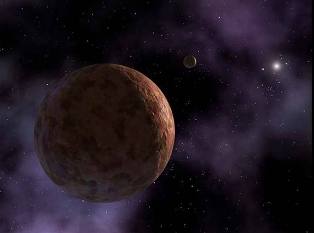
LONDON : Astronomers have discovered a mysterious dwarf planet that is three times farther away than Pluto and believed to be the most distant object in our solar system.
The discovery of the dwarf planet known as V774104 was announced Tuesday at a meeting of the American Astronomical Society near the US capital and could indicate the presence of more rogue planets in our celestial neighborhood. The dwarf planet currently sits 15.4 billion kilometers (9.6 billion miles) from the Sun.
It is believed to be between 310 and 620 miles across. Scott Sheppard, an astronomer at the Carnegie Institution for Science in Washington, announced the discovery and said its orbit remains unknown, for now. “It could end up joining an emerging class of extreme solar system objects whose strange orbits point to the hypothetical influence of rogue planets or nearby stars,” said a report in the journal Science.
The discovery was made using Japan’s eight-meter (25 feet) Subaru Telescope in Hawaii. The dwarf planet lies at a distance of about 103 astronomical units (AU) away from the Sun. One AU is the distance between Earth and the Sun. Previously, the most distant solar system object was announced in 2005 – a dwarf planet named Eris that was 97 AU from the Sun.
“The discovery of V774104 is more proof that the solar system is bigger than we thought,” said Joseph Burns, professor of engineering and astronomy at Cornell University. “We need a little more time to pin down the orbit and determine the object’s exact size, but it must be big to see it at this distance.”

Related Stories

Tesla driverless system to use updated radar technology

byCT Report
12/09/2016

WASHINGTON: Electric carmaker Tesla announced Sunday it was upgrading its Autopilot software to use more advanced radar technology. In a...

Apple to develop its own self-driving technology

byCT Report
10/09/2016

SAN FRANCISCO: Apple may not become an automaker, but it still wants to develop its own self-driving technology. The iPhone-maker's...

NASA spots slowest known magnetar

byCT Report
10/09/2016

WASHINGTON: Astronomers have found evidence of a magnetar - magnetised neutron star - that spins much slower than the slowest...

‘YouTubers’ outshining old-school television

byCT Report
09/08/2016

SAN FRANCISCO: A media revolution is taking place, and most people over 35 years of age aren’t tuned in. Millennial...

Next Post

SpaceX completes design testing of SuperDraco engines

  • Terms and Conditions
  • Disclaimer

© 2011 Customs Today -World's first newspaper on customs. Customs Today.

No Result
View All Result
  • Transfers and Postings
  • Latest News
  • Karachi
  • Islamabad
  • Lahore
  • National
  • Chambers & Associations
  • Business
  • About Us

© 2011 Customs Today -World's first newspaper on customs. Customs Today.