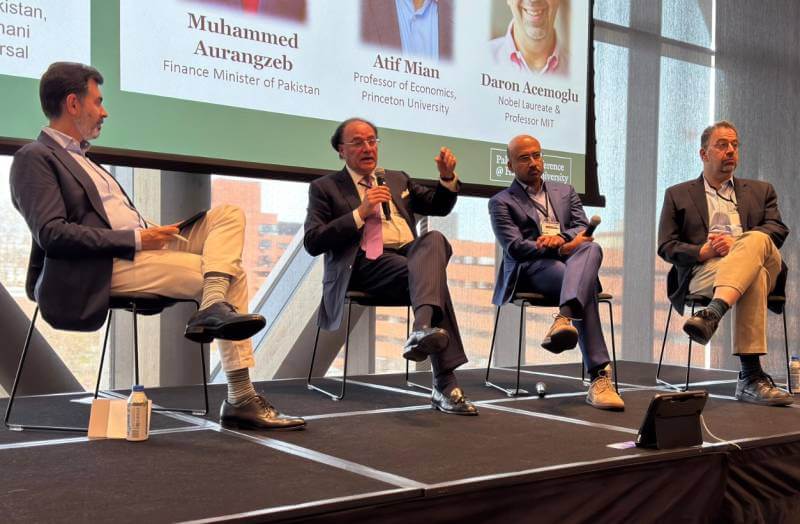
NEW YORK: Federal Minister for Finance and Revenue Senator Muhammad Aurangzeb on Monday highlighted Pakistan’s key reform priorities while participating in a high-level panel discussion at Harvard University on “Pakistan’s Economic Agenda: Stability, Reform and What Comes Next,” held as part of the Pakistan Conference 2026.
The session was moderated by Dr Reza Baqir, former governor of the State Bank of Pakistan, and featured distinguished panelists including Professor Atif Mian of Princeton University and Nobel Laureate Professor Daron Acemoglu of the Massachusetts Institute of Technology (MIT), said to a press release issued by the finance ministry in Islamabad.


The discussion brought together leading economists, policymakers, and members of the Pakistani diaspora to deliberate on Pakistan’s economic outlook, reform priorities, and long-term growth trajectory.
The minister described the ongoing Middle East conflict as one of the most significant supply shocks the global economy has witnessed in recent years, requiring careful and calibrated policy management.
He highlighted that Pakistan’s immediate priority over the past several weeks had been to ensure uninterrupted energy supplies across critical sectors, despite limited strategic reserves, through coordinated efforts across key ministries and institutions.
He noted that the government initially introduced a blanket subsidy to cushion the public from rising energy costs, which has since transitioned into full price transmission supported by targeted subsidies, in line with available fiscal space.
The Finance Minister emphasized that Pakistan has managed the situation relatively well compared to many countries, avoiding severe supply disruptions or law and order challenges.
On the external front, Aurangzeb underscored the government’s strong debt management, noting that the recent Eurobond repayment was a “non-event”, and expressed confidence in Pakistan’s ability to meet upcoming external obligations in a timely manner.
Highlighting emerging opportunities amid the crisis, he pointed to a significant surge in transit flows through Karachi Port, which in just a few weeks exceeded the entire volume recorded in 2025, as well as progress toward operationalizing Gwadar Port.
He also noted a record monthly inflow in March under the Roshan Digital Account initiative, indicating renewed confidence among overseas Pakistanis.
At the same time, the minister emphasized that remittances, while important, cannot serve as a sustainable long-term growth model, underscoring the need to focus on export-led growth and expansion in trade in services as more durable drivers of economic resilience.
Senator Aurangzeb candidly observed that Pakistan has long understood the “what” and “why” of economic reforms, but the core challenge lies in the “how” – particularly in ensuring timely decision-making and execution. He noted that delays in taking difficult but necessary decisions have historically undermined progress, contributing to recurring economic cycles and repeated reliance on IMF programmes.
He reaffirmed the government’s commitment to structural reforms, including improving tax administration, broadening the tax base, and increasing the tax-to-GDP ratio, which has shown progress but remains below desired levels.
He highlighted ongoing transformation efforts within the Federal Board of Revenue, focusing on digitization, automation, and data-driven systems to reduce human discretion and enhance efficiency.
Aurangzeb further emphasized the need to move away from a model of perpetual subsidies for industry, advocating instead for competitiveness and export-led growth. In this context, he highlighted recent trade liberalization measures, including tariff rationalization, aimed at encouraging efficiency and integration into global markets.
He also highlighted Pakistan’s growing renewable energy capacity, noting that solar generation has reached approximately 8,000 MW, which helped cushion the economy during recent external shocks. He underscored the government’s ambition to significantly increase the share of renewables in the energy mix over the coming decade.
The minister further noted key reform milestones, including the passage of agriculture income tax legislation by all four provincial assemblies, and progress in privatization and right-sizing of state-owned enterprises, with 28 SOEs referred to the Privatization Commission to reduce fiscal burdens and improve governance.
Looking ahead, Senator Aurangzeb underscored two critical, long-term challenges facing Pakistan: population growth and climate change. He emphasized that sustained economic progress would not be possible without addressing rapid population growth, while also highlighting Pakistan’s increasing vulnerability to climate-related shocks and the need for greater focus on resilience and adaptation.
He acknowledged that further work is required in areas such as regulatory reform and ease of doing business, noting that these remain key priorities for improving the investment climate.
The discussion provided an important platform for engagement with global thought leaders and stakeholders, reflecting Pakistan’s commitment to transparency, reform, and constructive dialogue on its economic future.