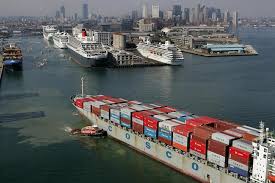
WASHINGTON: The port of Boston moved a step closer being able to handle some of the the larger ships able to traverse the expanded Panama Canal, after Massachusetts legislators approved $107.5 million in funding toward the project.
The ability to handle ships up to 12,000 twenty-foot-equivalent units would make the small port more competitive with its neighbor and the largest East Coast container gateway, the port of New York and New Jersey. Shippers’ frustration with NY-NJ congestion has helped fuel a double-digit year-over-year annual volume gain at the Boston port, which has to date handled ships only up to 8,500 TEUs.
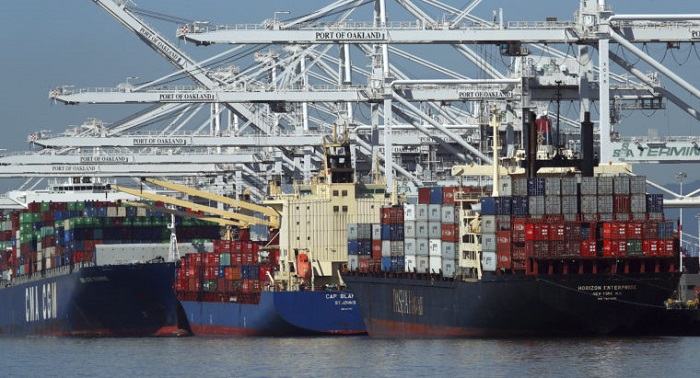

The funding would provide just more than half of the $200 million needed to create a 50-feet deep berth at Conley Container Terminal, creating the third berth in the terminal, and — once a variety of upgrades are complete — the second that will be able to handle mega-ships. The Massachusetts Senate approved the funding, part of a wide-ranging economic development bill, Thursday, after earlier approval from the House. Legislators in both houses now need to agree on a final bill, and send it to Gov. Charlie Baker. Port officials are confident he will back the plan.
The legislature’s vote followed the award last week of $42 million by the U.S. Department of Transportation to help fund modernization of an existing berth in the terminal, including repairing, strengthening and deepening two existing berths, one to 50 feet, and building a new technology equipped gate. The grant — made under the FASTLANE program, which was created to fund critical freight and highway projects across the country — requires Congressional approval to move ahead, a decision expected to come after a 60-day review period.
Officials at the port, known as Massport, said they have worked hard to improve productivity at the port, and position it in the future as an important East Coast destination. If all goes to plan, they expect to be able to handle ships up to 12,000 TEUs, said Port Director Lisa Weiland.
“We are a regional port and importers and exporters value direct call service,” she said. “We can be an efficient alternative to the Port of New York and New Jersey in terms of servicing New England cargo. So I think there is a recognition that Conley fits well into the nation’s freight picture.”
Weiland said the port has made productivity gains as a result of the administration working closely with the International Association of Longshoremen, as well as efforts to reduce congestion at the port, Weiland said. “Trucks can get in and out of our port in about 31 minutes,” she said. The port‘s monthly container figures support the claim. Loaded TEUs for exports and imports have increased by double digits over the year before in four of the first six months of the year, with imports falling only in March and exports declining only in June.
Loaded TEU exports increased by 17 percent in the first half of the year, and loaded imports increased by 11 percent, with the volume of all TEUs — loaded and unloaded — increasing by 9.4 percent. In 2015, loaded exports increased by 5.4 percent and loaded imports by 8 percent, and the volume of all TEUs increased by 10.7 percent.
The port also has improved efficiency: this year it was one of three North American ports on JOC.com’s list of “most improved” ports, with a 10 percent increase in berth productivity from 2014 to 2015.
That has certainly helped the port promote itself as an alternative to New York and New Jersey, which has suffered sporadic bouts of congestion and delays at its terminals in recent years. Asked if Boston’s gains have come at the expense of the Port of New York and New Jersey, Wieland said: “I think our numbers speak for themselves. The fact that we continue to see our numbers up, the double-digit growth, suggests that we are gaining share. I think we are capturing more of the New England bound cargo than perhaps we were capturing before.”
The fruits of those efforts were evident in April, when the port received its largest ship, an 8,500 TEU vessel. Starting this Sunday, vessels of the same size stop weekly at the port, after the CKYHE Alliance — whose members are Cosco, “K” Line, Yang Ming Line, Hanjin Shipping and Evergreen Line — decided to send larger ships on the route from Asia, which also stops in New York and Norfolk. The alliance had previously sent ships in the 4,000-TEU to 6,000-TEU range. Boston has two other services, to Northern Europe and the Mediterranean, which each send one ship a week.
Port officials say that with the state funding in place, the port will cover the remainder of the project budget, and they have already begun preliminary design and permitting for the project. The funding includes money for three new cranes for the berth, which have to be lower than normal cranes that handle large ships so as to be below the flight paths of nearby Logan International Airport.
“There is broad recognition that Conley is a vital asset to the state of Massachusetts, that businesses across the state rely on Conley to have access to global markets to import and export their goods,” Weiland said, adding that the majority of the port’s business comes from within a 150-mile radius. “So we are confident that there is broad support for this project.”
The port also is waiting for about $220 million in federal funds for the port’s dredging project, which was approved by congress in 2014, but the money has yet to appropriated, Weiland said. The remainder of the $350 million project cost — which will deepen the entrance channel from 45 feet to 51 feet, and the main channel from 40 feet to 47 feet — will be funded locally. The first part of the project, creating a confined aquatic disposal cell in which to store dredged material, will begin in the fall, and maintenance dredging of the existing berths will start in the spring.