ISLAMABAD: The Ministry of Petroleum and Natural Resources is awaiting approval of the Central Development Working Party (CDWP) and Executive Committee of the National Economic Council (Ecnec) are applying for foreign funding to lay pipeline on Pakistani side under the Iran-Pakistan (IP) gas pipeline project after lifting of international sanctions on Iran.
“To formally apply for financing as Buyer’s Credit, as per procedure, the PC-I of the project needs to be approved by the CDWP and Ecnec. The PC-I has been submitted by the ministry and approval of the same is awaited,” a senior official of the ministry told APP.

After lifting of the sanctions on Iran, he said, Ministry of Foreign Affairs was of the view that by and large, most of the sanctions, but a few in specific cases, had been withdrawn. Whereas, the remaining restrictions pertained mainly to nuclear and arms related transactions and entities, he added.
“Accordingly, to comply with the UNSC resolution regarding the sanctions lifting, Pakistan has issued Statutory Regulatory Order (SRO) on February 19, 2016 lifting sanctions on Iran,” the official informed.
Following the CDWP and Ecnec’s go-ahead signal, he said, the ministry would approach China through the Economic Affairs Division for financing the project, and Economic Coordination Committee for constitution of a Price Negotiation Committee to recommend acceptance of the price proposal of China Petroleum Pipeline-the project executing company.
“Given the loss of time due to ‘Force Majeure’ situation,” he said the IP project timelines needed to be extended, adding that Pakistan was already working on the project under the alternative strategy.
So, he said, Pakistan’s proposal to amend the Gas Sale Purchase Agreement (GSPA) to complete the legal formalities would hopefully be accepted by Iran.
“The details, in this regard, can be sorted out by the Experts Group, which should meet to discuss and decide on all outstanding matters,” he said.
Recently, the official said, Iran had invited Minister for Petroleum and Natural Resources Shahid Khaqan Abbasi to visit Tehran to discuss way forward on the project, which would be undertaken after approval of the competent authority.
Sharing details of the project, he said Inter-Governmental Framework Declaration was signed between the two countries on May 24, 2009, while GSPA had reached on June 2009. Subsequently, Pakistan issued sovereign guarantee on May 28, 2010. Project consultant was appointed on April 11, 2011, while the design, feasibility, route survey and other formalities of the project were completed on September 8, 2012.
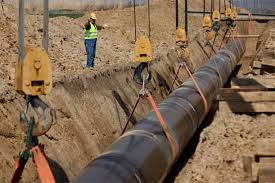
The 56-inch diameter pipeline will initiate from South Pars gas field Iran and end at Nawabshah covering a distance of around 1,931 kilometre with 1,150 km portion in Iran and 781 km in Pakistan.
The implementation is to be done on the basis of a segmented approach whereby each country will be responsible for construction of pipeline in the respective territory.
The 750 mmcfd gas flow in the pipeline is projected to help generate around 4,000 MW electricity also, along with creating job opportunities in backward areas of Balochistan and Sindh.
With the present government firmly resolved and making all efforts to bring the project to fruition, the official voiced high hopes that gas shortfall problem would be solved within the remaining period of the PML-N government. If all goes well, the project will start supplying gas in two years after initiation of the construction work.