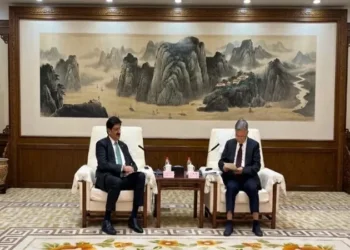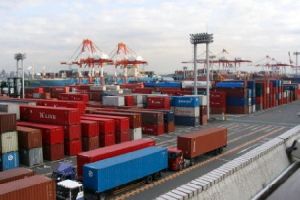
BEIJING: Nepal and China are going to start talks from tomorrow on customs time harmonisation, infrastructure development at new customs points and quarantine-related issues to facilitate bilateral trade. In this regard, a six-member
Chinese delegation led by Long Cheng Wei, deputy director general (DDG) of Customs Department of Tibet Autonomous Region (TAR) arrived here today.

Nepali delegation led by Damodar Regmi, deputy director general of Department of Customs, will hold talks with the Chinese delegation. Reportedly, both sides will sign agreements on some crucial issues on Thursday, which will provide necessary impetus to enhance bilateral trade.
Nepal will request China to simplify the duty-free quota-free (DFQF) facility that has been extended to Nepal. China has extended DFQF facility to 8,030 Nepali goods in all tariff lines. However, due to non-tariff measures set by the Chinese government, Nepal has not been able to reap the benefits from this facility.
Currently, Nepal has been facing huge trade gap with China. Trade deficit with China stood at Rs 97.934 billion in last fiscal, as Nepal had imported goods worth Rs 100.17 billion against export of Rs 2.23 billion to northern neighbour, as per Nepal Rastra Bank’s data.
According to Regmi, head of the delegation from Nepal side, Nepal will formally approach China to modify the harmonised system code (HS code) of the products to six digits from the existing eight digits.
Likewise, discussions pertaining to harmonisation of working hours at the customs point will also be held. Working time harmonisation will expedite customs clearance processes. Due to lack of working hour harmonisation between the two sides, traders have been compelled to spend more time at the border for customs clearance. It is expected that harmonisation of working hours will shorten the travel time of cargoes and the cost of trade will be minimised to some extent, which in turn will benefit the traders and ultimately the consumers.
Nepal and TAR will talk on building understanding in providing mutual recognition for quarantine certification of each other’s products. Reportedly, recognition of certificates issued by quarantine labs of the two neighbours will also reduce the number of non-tariff measures imposed by both nations to give access to goods in their respective markets.
Similarly, the meeting will also discuss developing infrastructure at the new customs points, namely, Yari, Humla-Poraag; Olangchung Gola, Taplejung-Riwa; Jumla-Penan; Mustang-Lizi; Larke, Gorkha-Tibet and Kimathanka, Sankhuwasabha-Riwa in a bid to boost bilateral trade.