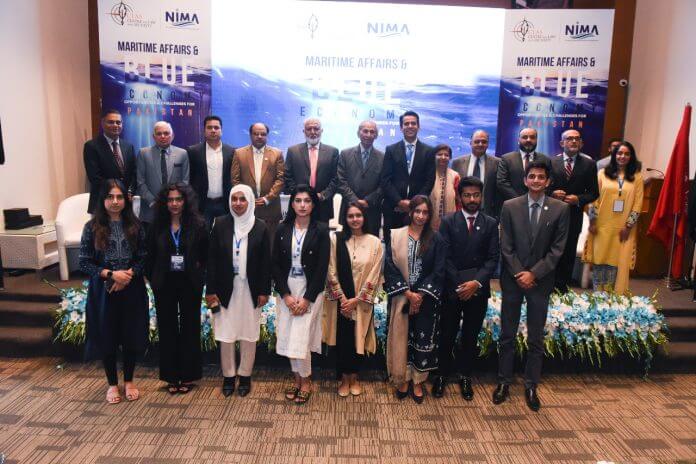
ISLAMABAD: Centre for Law and Security (CLAS), in collaboration with the National Institute of Maritime Affairs (NIMA) held a one-day conference on Pakistan’s Maritime Security and Blue Economy at TMUC Forum.
The speakers at the conference focused on providing concrete recommendations concerning the way forward for Pakistan regarding the full potential of its maritime boundary and realizing the goal of economic development through its seas.


Director National Institute of Maritime Affairs Baber Bilal Haider SI (M) while participating in the event emphasized the significance of CPEC for developing a Blue Economy and Regional Connectivity.
He stressed that the 110million cargo being transported through Pakistan waters has affected maritime tourism and resulted in dirty beaches. Focusing on CPEC and the Gwadar port, he reiterated that unless all the power plants would be fully operational, only then can Pakistan claim to progress.
International relations expert Dr Huma Baqai joined virtually to discuss the role of the government in pursuing Pakistan’s Maritime interests.
She started by stating that Pakistan needed to realize its Maritime potential, and it also needs maritime security and protection. She further touched base on governance issues regarding the coastal area and disapproved of the declining shipping capacity and development of maritime industrial zones.
Professor at the School of Politics and International Relations, Quaid-i-Azam University Dr Zafar Nawaz Jaspal spoke about the wake of emerging Indo-Pacific Alliances such as QUAD and believed that the world is changing. Pakistan needed to form a coherent National Security Plan for its Maritime affairs, and Pakistan needed to form Counter Alliances to pursue its Maritime interests.
Professor Dr Nazir Hussain discussed the prospects of Pakistan’s Maritime Regional Collaboration. He asserted that Pakistan did not have enough data to move forward with regional collaboration. However, policy papers being developed may have potential.
V/Adm Ahmad Tasnim HI(M) SI(M) SS(M) SB(M) SJ(M) was of the view that Blue Economy cannot be detached from the main economy, Maritime laws about shipping, ports, coastal zones, and explorations need to be developed and conducted.
Cdre (Retd.) Zafar Mansoor Tippu emphasized that EEZ and CS under UNCLOS had multiple challenges from governance, structural, socioeconomic, surveys, research, security, and environmental. However, Pakistan has an opportunity for capacity building in its implementation and should also consider training personnel in the development of the Blue Economy.
Professor Dr Shaheen Akhtar talked about sustainable growth in its unexplored maritime resources. She iterated that the exclusive geostrategic position of Pakistan lends its ports a unique significance concerning maritime trade. Furthermore, the construction of Gwadar as a transit and transshipment port under CPEC has further augmented Pakistan’s maritime potential as a key player in the Indian Ocean Region.
Dr Masood Khattak spoke regarding Pakistan’s Maritime Interests in the Indian Ocean. He emphasized that the Indian military modernization is happening at a rapid scale and is a pertinent challenge to the deterrence stability of south Asia.
The conventional balance of power in south Asia would dangerously tilt in favour of India and seriously challenge Pakistan’s sovereignty and territorial integrity. He believed such a development would compel Pakistan to rely on its nuclear weapons to deny any conventional or technological advantage to India.