

Customs Today
  • Home
  • Islamabad
  • Karachi
  • Lahore
  • National
  • Transfers and Postings
  • Chambers & Associations
  • Business
No Result
View All Result
Customs Today
  • Home
  • Islamabad
  • Karachi
  • Lahore
  • National
  • Transfers and Postings
  • Chambers & Associations
  • Business
No Result
View All Result
Customs Today
No Result
View All Result
Home Uncategorized

Discovery of 3.3 million years old stone confirms theory of early humans

byCustoms Today Report
22/05/2015
in Uncategorized
Share on FacebookShare on Twitter

You might also like

Pakistan to get $3b loan from Islamic Trade Financing Corporation

20/10/2024

Lahore I&I & Enforcement anti-smuggling operations achieve record success in early FY 2024-25

10/09/2024

VERIA: For years, conventional thought has held that humans were the first to start using stone tools. In Stanley Kubrick’s classic film “2001: A Space Odyssey” it is the invention of the bone club that sparks the evolution of man. But a recent discovery might prove that both popular thought (and Stanley Kubrick) may have had it wrong, stone tools have been around for a lot longer than the human lineage.
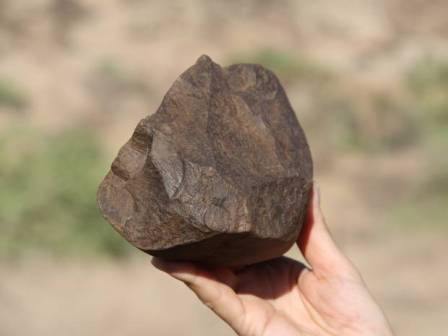
A collection of sharpened shards, currently considered the oldest handmade stone tools yet discovered, has captured the attention of anthropologists and archaeologists around the world. According to a study published by the journal Nature on May 21, the tools prove that human ancestors were capable of shaping stone into blades nearly 3.3 million years ago, beating the previous record holder for oldest stone tool by an overwhelming 700,000 years.
While chimpanzees and other monkeys are known to use basic tools, like rocks to crack open nuts and sticks to fish insects out of the ground, scientists have long thought that it was only members of the direct human lineage, specifically of the genus Homo, that could manufacture their own tools out of stone. The recent discovery has many rethinking how evolutionary and environmental factors affected ancient human ancestors.
The discovery of the tools turned out to be a lucky accident that occurred when a group of archaeologists were driving around near Lake Turkana in Kenya. “We were driving in the dry riverbed and took the left branch instead of the right, and got off course,” Sofia Harmand, lead author on the study, told Live Science. “Essentially, we got lost and ended up in a new area that looked promising. Something was really unique about this place, we could tell that this zone had a lot of hidden areas just waiting to be explored.”


Related Stories

Pakistan to get $3b loan from Islamic Trade Financing Corporation

byCT Report
20/10/2024

ISLAMABAD: Islamic Trade Financing Corporation (ITFC) to provide Pakistan with a $3 billion loan, according to an official statement released...

Lahore I&I & Enforcement anti-smuggling operations achieve record success in early FY 2024-25

byCT Report
10/09/2024

LAHORE:  Regional Directorate of Customs Intelligence & Investigation has demonstrated exceptional performance in the first two months of the fiscal...

ICCI and CDA to join hands for tree plantation drive in Capital

byQaisar Mansoor
09/08/2023

ISLAMABAD: Islamabad Chamber of Commerce and Industry (ICCI) in collaboration with the Capital Development Authority (CDA) would jointly launch a...

Customs Officials Yawar Abbas & Tariq Mehmood kidnapped in Karachi

byCT Report
08/07/2023

KARACHI: Customs Intelligence Officer Yawar Abbas and Customs Preventive Officer Tariq Mehmood who were working against smuggling were kidnapped by...

Next Post

HTC's J Butterfly 3 to appeal fans

  • Terms and Conditions
  • Disclaimer

© 2011 Customs Today -World's first newspaper on customs. Customs Today.

No Result
View All Result
  • Transfers and Postings
  • Latest News
  • Karachi
  • Islamabad
  • Lahore
  • National
  • Chambers & Associations
  • Business
  • About Us

© 2011 Customs Today -World's first newspaper on customs. Customs Today.