SAN FRANCISCO: The diversion of cargo from West Coast ports this past year taught East and Gulf Coast ports a valuable lesson. They better start planning now if they are going to be prepared for another spike in cargo volumes next spring with the completion of the Panama Canal expansion project.
The Port of Houston was a major beneficiary of the cargo diversions that resulted from the West Coast labor slowdowns and port congestion in recent months, with container volume growing 30 percent, said Roger Guenther, executive director. “You can’t plan for 30 percent growth in cargo,” he told the annual conference of the Agriculture Transportation Coalition at the weekend.
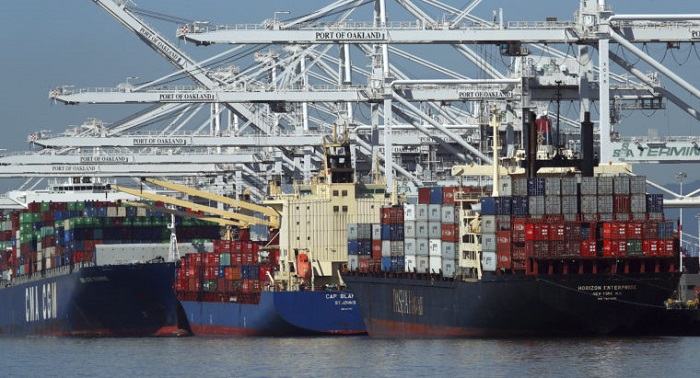

As the largest container port on the Gulf Coast, with a location closer to importers and exporters in the West than any of the alternative U.S. ports, Houston was a popular gateway for diverted cargo. “We were tested, our labor force and our truckers,” Guenther said. Agricultural exporters who diverted shipments to Houston confirmed there was a shortage of drayage capacity, with one shipper saying she would order 10 trucks each day and receive five.
The Virginia ports the past several years had struggled with terminal congestion. Earlier this year, when disruptions caused by weather conditions were compounded by a surge in diverted shipments from the West Coast, the congestion problems worsened, and truckers reported waiting in line for hours at the marine terminals. “We have certainly stumbled in taking on this wave of cargo,” said Thomas Capozzi, chief sales officer of Virginia International Terminals.
Capozzi noted that the Port Authority of New York and New Jersey also struggled with congestion due to cargo diversions. He said Charleston and Savannah seemed to be able to handle the extra volume.
East and Gulf Coast ports in the coming year will deal with two unknowns: how much of the market share that West Coast ports lost will stick now that the new five-year International Longshore and Warehouse Union contract has been ratified, and how much new volume will be generated when the Panama Canal expansion project is completed in the spring of 2016.
The extent of permanent cargo diversion will become clearer in the late summer and fall peak-shipping season when trans-Pacific container volume commitments contained in the new service contracts really begin to kick in.
While it is certain that the size of vessels transiting the Panama Canal will increase next spring, almost doubling from 4,800 20-foot-equivalent units to more than 8,000 TEUs, it is uncertain how much of the Panama Canal cargo will be new as opposed to being diverted from the Suez Canal route, which has no size restrictions.
That is the type of information East and Gulf Coast ports need to know as soon as possible, the port executives said, so they can properly allocate and utilize the resources they will need in the coming year. “Ports just can’t be there the instant capacity is needed,” Guenther said.
Ports such as Houston and the Virginia are already well along in planning for the longer term, with investments underway in marine terminal, truck and rail infrastructure. Houston had already been preparing for increased exports of plastics and resins do to the shale gas boom in Texas, Guenther said. Houston currently has two all-water services from Asia. Its channel draft of 45 feet will limit the size of fully-loaded mega-ships it can handle.
Virginia, which for some time now has had a 50-foot draft, should have no problem attracting the mega-ships that will call on the East Coast, at least until New York-New Jersey completes its project to raise the Bayonne Bridge so larger vessels can pass underneath. Virginia’s channel depth has been authorized for deepening to 55 feet, Capozzi said. Virginia has 14 weekly services from Asia.
Yet another unknown for East and Gulf Coast ports is how many container moves per vessel call will be generated from the big ships. As Los Angeles-Long Beach and New York-New Jersey have found out, handling the cargo surge from one mega-ship operated by a carrier alliance is much more difficult than handling the same amount of cargo spread out over two or three smaller ships calling at several terminals.
Los Angeles-Long Beach now averages more than 5,000 container moves per vessel call, but 10,000 or more moves per call is becoming common now. Carriers discharge and reload a disproportionately high percentage of the vessel’s volume in the first call’s inbound, which are usually made at the biggest ports on each coast.