

Customs Today
  • Home
  • Islamabad
  • Karachi
  • Lahore
  • National
  • Transfers and Postings
  • Chambers & Associations
  • Business
No Result
View All Result
Customs Today
  • Home
  • Islamabad
  • Karachi
  • Lahore
  • National
  • Transfers and Postings
  • Chambers & Associations
  • Business
No Result
View All Result
Customs Today
No Result
View All Result
Home Science & Technology Science

ESA’s Gaia satellite creates stellar density map of Milky Way

byCustoms Today Report
08/07/2015
in Science, Science & Technology
Share on FacebookShare on Twitter

You might also like

Tesla driverless system to use updated radar technology

12/09/2016

Apple to develop its own self-driving technology

10/09/2016

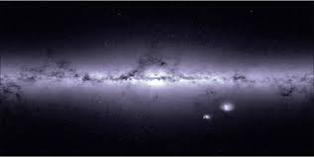
NEW YORK: This image, based on housekeeping data from ESA’s Gaia satellite, is no ordinary depiction of the heavens. While the image portrays the outline of our Galaxy, the Milky Way, and of its neighbouring Magellanic Clouds, it was obtained in a rather unusual way.
As Gaia scans the sky to measure positions and velocities of a billion stars with unprecedented accuracy, for some stars it also determines their speed across the camera’s sensor. This information is used in real time by the attitude and orbit control system to ensure the satellite’s orientation is maintained with the desired precision.
These speed statistics are routinely sent to Earth, along with the science data, in the form of housekeeping data. They include the total number of stars, used in the attitude-control loop, that is detected every second in each of Gaia’s fields of view.
It is the latter – which is basically an indication of the density of stars across the sky – that was used to produce this uncommon visualisation of the celestial sphere. Brighter regions indicate higher concentrations of stars, while darker regions correspond to patches of the sky where fewer stars are observed.
The plane of the Milky Way, where most of the Galaxy’s stars reside, is evidently the brightest portion of this image, running horizontally and especially bright at the centre. Darker regions across this broad strip of stars, known as the Galactic Plane, correspond to dense, interstellar clouds of gas and dust that absorb starlight along the line of sight.

Related Stories

Tesla driverless system to use updated radar technology

byCT Report
12/09/2016

WASHINGTON: Electric carmaker Tesla announced Sunday it was upgrading its Autopilot software to use more advanced radar technology. In a...

Apple to develop its own self-driving technology

byCT Report
10/09/2016

SAN FRANCISCO: Apple may not become an automaker, but it still wants to develop its own self-driving technology. The iPhone-maker's...

NASA spots slowest known magnetar

byCT Report
10/09/2016

WASHINGTON: Astronomers have found evidence of a magnetar - magnetised neutron star - that spins much slower than the slowest...

‘YouTubers’ outshining old-school television

byCT Report
09/08/2016

SAN FRANCISCO: A media revolution is taking place, and most people over 35 years of age aren’t tuned in. Millennial...

Next Post

Astronomers are witness of high-energy cosmic fireworks set to occur in early 2018

  • Terms and Conditions
  • Disclaimer

© 2011 Customs Today -World's first newspaper on customs. Customs Today.

No Result
View All Result
  • Transfers and Postings
  • Latest News
  • Karachi
  • Islamabad
  • Lahore
  • National
  • Chambers & Associations
  • Business
  • About Us

© 2011 Customs Today -World's first newspaper on customs. Customs Today.