LAHORE: Government would have to initiate tax reforms in consultation with the stakeholders to bring non-taxpayer sectors into the tax net as Pakistan with the population of over 186 million only has 5.7 million eligible taxpayers, 3.6 million tax registered, 0.8 million tax filers and only 0.5 million direct taxpayers.
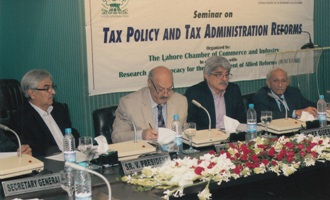
Pakistan is in a dire need for tax reforms to boost tax-to-GDP ratio which is one of the lowest in the world. All this was stated by the experts at a seminar on “Tax Policy and Tax Administration Reforms” jointly organized by the Lahore Chamber of Commerce and Industry (LCCI) and Research and Advocacy for the Advancement of Allied Reforms (RAFTAAR) here at the LCCI on Thursday.


The LCCI President Sheikh Muhammad Arshad, Senior Vice President Almas Hyder, former finance minister Dr. Salman Shah, former economic advisor of the ministry of finance Sakib Sherani, Dr. Hanid Mukhtar, Fasi Zaka, Dr. Ijaz Nabi, Mustafa Omer, and former LCCI president Bashir A. Baksh were prominent amongst the other experts. The LCCI Executive Committee Members were also present on the occasion.
Former finance minister Dr. Salman Shah said that Pakistan’s economic growth has slowed sharply since 2009. GDP growth has averaged 3.2 percent during this period. He said that significant structural and institutional reforms are needed to re-invigorate economic growth and to improve the income and welfare levels of Pakistan’s poor. He said that strengthening the reform process is a two-fold process: it requires on the one hand, greater engagement of citizens/public and on the other, preparing and equipping decision-makers to make the case for reform more widely.
The LCCI President Sheikh Muhammad Arshad said that most of the challenges being faced by the economy are directly linked to complicated and lengthy taxation procedures. Therefore, government would have to make taxation system business friendly through due consultation with the stakeholders as being done in the EU states.
He said that flaws in taxation system causing loss of billions of rupees to the national exchequer. He said that tax reforms like developed countries could enhance the government revenue.
“The Lahore Chamber of Commerce and Industry believes that for the promotion of tax culture in Pakistan, the government would have to bring down the rate of the taxes besides bringing the untaxed sectors into the tax net”, Sheikh Muhammad Arshad added.
He said that Pakistan was the rising star in 1960s and a number of countries adopted Pakistan as role model but now situation is quite different and now those countries are far ahead which were following us.
He said that in 2007 Large Scale Manufacturing Sector share in GDP, employment and private investment was 12.2 percent, 13.7 percent and 22.2 percent that has gone down to 10.9 percent, 14 percent and 10.1 percent respectively in 2014. It should be an eye opener for the policy makers.
The LCCI Senior Vice President Almas Hyder said that Pakistan’s infrastructure quality lags behind that of comparator countries while the gap with comparators is also widening which should be controlled with effective efforts.
Former Economic Advisor of the Ministry of Finance Sakib Sherani said that Economic reform advocacy in Pakistan has been fragmented as different stakeholder groups have pursued their narrow interest, mostly in silos. There is great opportunity for stakeholder groups to organize and collectively demand reforms from policy makers.
He said that Pakistan needs to invest more to growth. He said that Pakistan’s spending on core government functions is low. A large part of core spending is financed through fiscal deficits. He said that increasing core spending exacerbates the debt problem which further erodes future fiscal space.