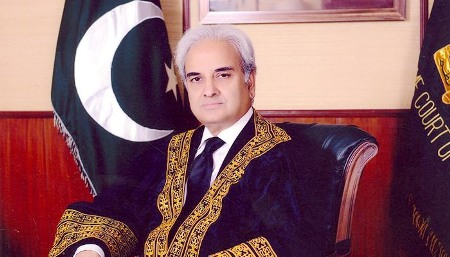
ISLAMABAD: Federal Board of Revenue Chairman Tariq Mahmood Pasha has briefed caretaker prime minister Nasirul Mulk on revenue collection.
Sources said that the FBR chairman Tariq Pasha informed the PM that the board would not be able to achieve the revised tax collection target of Rs3.935 trillion.


Secretary Finance Arif Ahmad Khan and the Economic Affairs Division (EAD) also briefed the caretaker prime minister on the country’s economic situation.
The sources said that the finance secretary also informed the PM that the budget deficit – the gap between expenditure and revenue – will be far greater than the revised target of 5.5 per cent of GDP or Rs1.8 trillion. The caretaker PM was also told that the deficit could surge above 6.5 per cent of GDP.
Budget deficit during the first nine months (July-March) also widened to a new record of Rs1.481 trillion, amounting to 4.3 per cent of GDP.
Contradicting the PML-N’s claims of economic turnaround, the Ministry of Finance on Monday warned the caretaker prime minister that without the support of the International Monetary fund (IMF), the country’s financial survival was at stake.
The finance secretary is reported to have told caretaker Prime Minister Nasirul Mulk that the country would have no other option but to seek IMF help.
Terming the briefing candid, another government official said that everything was laid bare before the caretaker PM.
The finance secretary’s assessment is in total contradiction to the claims of the PML-N government whose term expired last Thursday.
The caretaker PM was informed that the previous government had already obtained foreign commercial loans in addition to floating eurobonds to bridge the widening current account deficit.
The current account deficit – the gap between external receipts and payments – widened to a record $14 billion during the July-April period of the ongoing fiscal year, according to the State Bank of Pakistan (SBP) statistics.
Pakistan’s external financing needs for the next fiscal year needed to be met by exploiting all available options, including the IMF, sources quoted the secretary finance as having told the caretaker prime minister.
In its last assessment, the IMF evaluated that Pakistan needed financing of $27 billion for fiscal year 2018-19, beginning in July this year.
The PM was informed that as of May 18 this year, the country’s gross official foreign exchange reserves stood at $10 billion and were insufficient to support payments for imports of more than two months.
According to the finance ministry, by August this year, there should be some kind of arrangement with the IMF to handle the external payment pressure, the sources said.
The PM was informed that a delayed decision on devaluation of rupee against the US dollar also caused fast depletion of foreign currency reserves. High import bill, needed for meeting the country’s economic expansion, and low quantum of exports were major factors contributing to high debt levels and low foreign currency reserves.