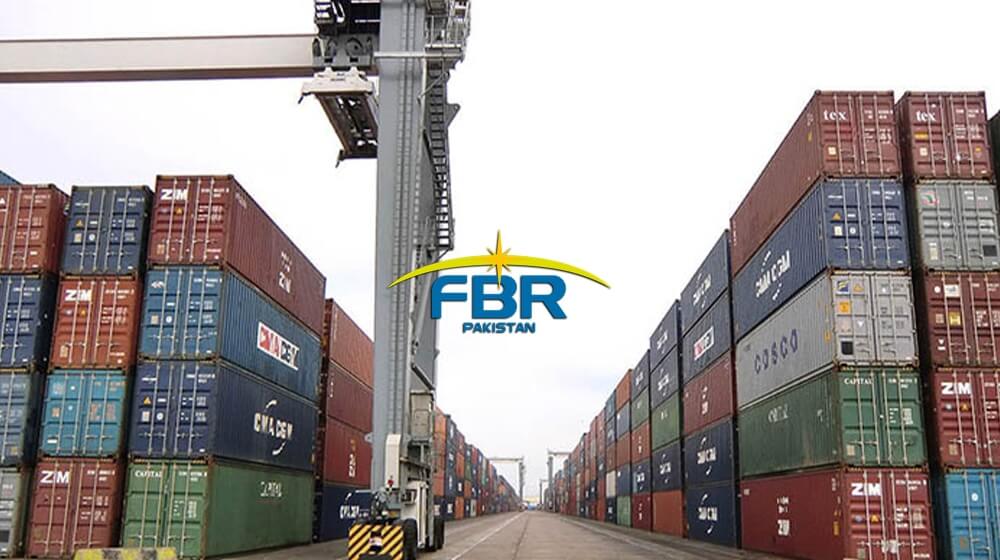
ISLAMABAD: The Federal Board of Revenue (FBR) has proposed significant reductions in the scanning and physical examination of transit trade consignments, issuing draft amendments to the Customs Rules, 2001. This move, detailed in SRO 1062(I)/2025 dated June 17, 2025, is designed to facilitate smoother cargo movement and enhance overall trade efficiency across Pakistan’s ports.
Under the proposed changes, the selection ratio for transit cargo by the Risk Management System (RMS) of Pakistan Customs will be sharply decreased. Only 10% of transit goods will now be selected for scanning, a substantial reduction from the current 25%. Furthermore, merely 5% of consignments will be chosen for physical examination, down from the existing 10%.


Streamlining Port Operations and Cargo Movement
According to the draft amendments, Rule 473 of the Customs Rules will be revised to implement these reduced thresholds at Pakistan’s key seaports, including Karachi, Port Muhammad Bin Qasim, and Gwadar. Once a goods declaration (GD) is filed, a significantly minimal percentage of transit consignments will be subjected to inspection. Consignments that are cleared through the RMS will be directly forwarded to the terminal operator for delivery and to the sealing officer for secure onward transport.
The FBR has also proposed corresponding revisions in sub-rule 3 of Rule 475 and sub-rule 1 of Rule 484E to ensure consistency and uniformity across all transit cargo procedures. These amendments are geared towards streamlining customs operations, minimizing delays, and reducing congestion at the nation’s vital ports. Such efficiencies are crucial for facilitating Pakistan’s growing transit trade relationships with neighboring countries.
A Shift Towards Trade Facilitation
Notably, these latest amendments represent a strategic shift from previous measures. Through SRO 1401(I)/2023, issued on October 7, 2023, the FBR had actually increased the threshold for scanning to 25% and examination to 10%, in an effort to strengthen border control and combat illicit trade. The current proposals, however, reflect a renewed focus on efficient trade facilitation while still maintaining effective risk management protocols.
Industry stakeholders have largely welcomed the proposed changes, viewing them as a positive and necessary step towards modernizing customs processes. They believe this will significantly enhance Pakistan’s reputation as a reliable and efficient transit trade hub in the region. The FBR is currently seeking public and industry feedback on these draft amendments before their finalization and implementation, underscoring a consultative approach to these reforms.
These reforms are closely aligned with the government’s broader agenda to simplify trade procedures, improve logistics infrastructure, and strengthen regional connectivity, thereby boosting Pakistan’s role in regional commerce.