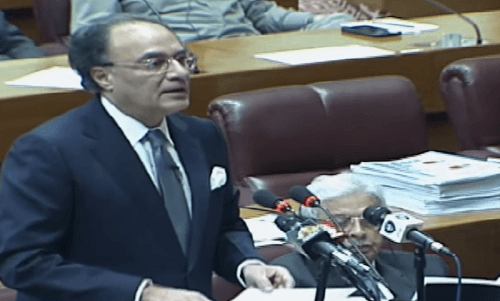
ISLAMABAD: Finance Minister Muhammad Aurangzeb presented the Budget 2025-26 in the National Assembly, calling it an honour to present the upcoming fiscal year’s financial plan.
Addressing the House, the finance minister congratulated Pakistan’s military and political leadership, highlighting the country’s exceptional success against its enemies. “Our armed forces displayed extraordinary capability and responded to threats with full strength,” he said


Aurangzeb revealed that additional customs duty will be phased out in four years, while regulatory duty will be eliminated over five years.
He also announced the complete abolition of the Fifth Schedule of the Customs Act 1969 within five years, calling it a necessary step towards simplifying the tax system.
As part of customs reforms, the number of customs duty slabs will be reduced to four, and the maximum customs duty rate will be lowered from 20 percent to 15 percent.
Aurangzeb stated that this is the second budget presented by the coalition government, underlining key achievements including a primary surplus of 2.4 percent of GDP. He noted that due to the government’s measures, the inflation rate has declined significantly, now standing at 4.7 percent.
The Budget 2025-26 session was marked by chaos as opposition parties, including PTI and Sunni Ittehad Council members, protested loudly in the House.
They tore up copies of the budget documents and threw them into the air, chanting slogans. PTI’s parliamentary party rejected the IMF-backed budget, claiming the government had no right to present it.
During the uproar, PML-N lawmakers gathered near the Prime Minister’s seat. Prime Minister Shehbaz Sharif was seen meeting with party members including Tahira Aurangzeb, Nuzhat Sadiq, Khalil Das Kohistani, Anjum Aqeel, and Malik Abrar.
Highlighting economic performance, the finance minister stated that the current account deficit stood at $1.7 billion in the previous fiscal year, but the current year closed with a surplus of $1.5 billion due to government interventions.
The finance minister highlighted that these reforms will benefit multiple sectors, including pharmaceuticals and IT, and help reduce the average tariff, making Pakistan’s trade regime one of the most competitive in the region.
In a significant move, the government also announced its decision to expand water storage infrastructure on an emergency basis.
On financial innovation, the minister confirmed that preparations for launching Panda Bonds have been completed, paving the way for Pakistan to access China’s capital market and attract foreign investment.
Regarding SOEs, Aurangzeb stated that the classification of all state-owned entities under the SOE reforms has been finalised.
He highlighted the fiscal burden caused by inefficient SOEs, which cost the government over Rs 800 billion annually. These reforms aim to improve governance and reduce losses.
He said that foreign exchange reserves of the State Bank have gone up by $2 billion. These reserves are expected to reach $14 billion by the end of the year.
Speaking about Budget 2025-26, Aurangzeb announced that a 5 percent income tax has been imposed on annual pensions of over one crore rupees.
He also said the tax on cash withdrawals by non-filers is being increased from 0.6 percent to 1 percent.
He said FBR’s new digital system is helping to bring more people into the tax net. There will now be no income tax on people earning up to Rs 6 lakh per year.
People earning Rs 12 lakh per year will pay 1 percent tax. Those earning Rs 1.83 lakh per month will pay 12.5 percent, Rs 2.67 lakh will pay 22.5 percent, and Rs 3.33 lakh will pay 27.5 percent.
He confirmed that the privatization of PIA and Roosevelt Hotel will be ensured next year. Work on the privatization of DISCOs and GENCOs will also continue.
He revealed that the Cabinet has approved a reduction in the number of employees in 10 federal ministries. In total, 45 government entities will either be privatized or shut down.
The finance minister said that World Bank and IFC will provide $40 billion over 10 years to tackle environmental challenges.
He stated that pension reforms will be implemented in Budget 2025-26. Early retirement will be discouraged, and pension increases will be linked to inflation.
Finance Minister Muhammad Aurangzeb announced that the government has set a target to increase IT exports to $25 billion in the next five years under the Budget 2025-26.
He further shared that the government aims to provide Rs100 billion in financing to small and medium enterprises (SMEs) by 2028, adding that easy loan access will be ensured on relaxed conditions to promote small industries across the country.
The finance minister said low-income groups will be offered affordable loans for house construction or purchase. In this regard, the State Bank of Pakistan is expected to announce a special housing scheme soon for economically weaker sections of society.
Highlighting measures for overseas Pakistanis, Aurangzeb said that special courts will be established for overseas Pakistanis. An online system for case registration and submission of evidence, making legal processes easier and faster for the diaspora.
In Budget 2025-26, the government has allocated Rs 716 billion for the Benazir Income Support Programme.
From the current expenditures, Rs 140 billion has been set aside for Azad Jammu and Kashmir.
Rs 80 billion each has been allocated for the merged districts of Khyber Pakhtunkhwa and Gilgit-Baltistan.
The government has allocated Rs18 billion for Balochistan’s current expenditures, says Finance Minister.
The government has decided to end the distinction between filers and non-filers. Now, only those who submit a wealth statement will be allowed to make financial transactions, according to Finance Minister Muhammad Aurangzeb.
Non-filers will no longer be able to buy vehicles or property.
An 18 percent sales tax is being imposed on the import of solar panels. The Finance Minister clarified that this move is aimed at boosting local solar panel manufacturing in the country.
Under the special directive of the Prime Minister, funds have been allocated for the 813-kilometre-long N-25 highway connecting Karachi to Chaman in Balochistan.
A total of Rs 100 billion has been earmarked for this key infrastructure project.
Finance Minister Muhammad Aurangzeb announced that the sales tax rate on small vehicles is being increased from 12.5 percent to 18 percent in Budget 2025-26.
The government has allocated Rs 15 billion for the development of the motorway linking Karachi Port to Hyderabad and Sukkur.
In Budget 2025-26, the government has allocated Rs 19 billion for the upgradation of the Gadani Ship-Breaking Yard.
A total of Rs90 billion has been allocated for 47 schemes in the energy sector under the development programme.
Specific allocations include Rs1.8 billion for MEPCO, Rs1.9 billion for HESCO, and Rs2.4 billion for PESCO.
The withholding tax rate on property purchases in the housing sector has been reduced from 4 percent to 2.5 percent.
There is also a proposal to reduce the withholding tax on property purchases from 3 percent to 1.5 percent.
The Finance Minister announced that Federal Excise Duty has been eliminated on the transfer of commercial properties, plots, and houses.
The government will ease mortgage conditions for the construction of low-cost housing.
A new tax credit is being introduced for homes up to 10 marla and flats measuring up to 2,000 square feet.
Stamp paper duty on property purchases in Islamabad has been reduced from 4 percent to 1 percent.
The Finance Minister announced that tax on income earned from interest has been increased from 15 percent to 20 percent.
The increased tax on interest income will not apply to earnings from National Savings Schemes.