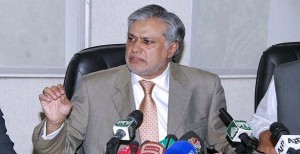
ISLAMABAD: Finance Minister Ishaq Dar along with his key economic team members, today (Wednesday) will brief the Council of Common Interests (CCI) on the progress regarding implementation of public debt management and supervision policy.
CCI in its previous meeting held in May 2014, took briefing from the Finance Minister in this regard and issued directions to further improve the enforcement of said policy. CCI will review progress on its decision on public debt management and supervision policy in a crucial meeting scheduled to be held today (Wednesday).

Government debt known as public debt, national debt and sovereign debt is the debt owed by a central government. The government debt” may also refer to the debt of a state or provincial, municipal or local government.) By contrast, the annual “government deficit” refers to the difference between government receipts and spending in a single year, that is, the increase of debt over a particular year.
Public debt is one method of financing government operations, but it is not the only method. Governments can also create money to monetize their debts, thereby removing the need to pay interest. But this practice simply reduces government interest costs rather than truly cancelling government debt,[3] and can result in hyperinflation if used unsparingly.
Governments usually borrow by issuing securities, government bonds and bills. Less creditworthy countries sometimes borrow directly from a supranational organization (e.g. the World Bank) or international financial institutions. As the government draws its income from much of the population, government debt is an indirect debt of the taxpayers.
Pakistan recorded a Government Debt to GDP of 63.30% of the country’s Gross Domestic Product in previous fiscal year. Government Debt to GDP in Pakistan averaged 69.94% from 1994 until 2013, reaching an all time high of 87.90%t in 2001 and a record low of 54.90 % in 2007. Government Debt to GDP in Pakistan is reported by the Central Bank of Pakistan. Generally, Government debt as a percent of GDP is used by investors to measure a country ability to make future payments on its debt, thus affecting the country borrowing costs and government bond yields.
In a meeting held on May 29, last year, the Finance Minister Ishaq Dar had briefed the CCI on Public Debt Management and supervision policy” a well placed source at Finance Ministry told this scribe here on Tuesday. In order to improve the Debt Management operation, government had initiated a process of preparing a comprehensive medium-term Debt strategy in consultation with all stakeholders. The strategy will facilitate in making strategic decisions for new borrowing including the appropriate mix between domestic and external loans to finance the budget deficit.
The agenda of the CCI’s today’s meeting reveals that Council of Common Interests will review the progress made by the Finance Ministry and concerned attached departments on the decision made in the previous meeting. Finance Minister Ishaq Dar along with his economic team managers will brief CCI on the current state of public debt in Pakistan as well as policy being followed by the Ministry to supervise it.
As per Fiscal Responsibility and Debt Limitation Act (FRDLA) total public debt must be below 60% of the GDP, however, this limit was crossed by the government in last May 2014 by borrowing funds from the International Monetary Fund (IMF).