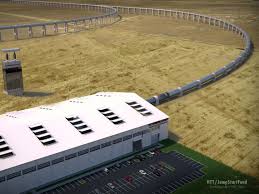
Today, in the desert outside Las Vegas, a start-up called Hyperloop One performed the world’s first full-scale test of hyperloop technology, and demonstrated that their propulsion system really works. According to reports, the motor inside their short test track was able to successfully accelerate a cart from 0 to 96 km/h (60 mph) in 1 second, generating a force of 2.5 Gs.
This initial test didn’t involve the famous ‘loop’ part of the technology, so doesn’t come close to demonstrating how fast those carts would move without air resistance. But based on these results, this same motor inside a full prototype could hypothetically propel a vehicle to incredible speeds of 1,126 km/h (700 mph).


Ever since Elon Musk came up with the idea of the hyperloop, people have been freaking out about it. The alternative to trains – and potentially even air travel – is powered by magnets, and travels inside a low-pressure tube, allowing it to reach theoretical speeds of up to 1,200 km/h (745 mph).
If constructed, a hyperloop could take you from LA to San Fransisco in just 30 minutes, or New York to China in 2 hours.
And now we have the first video evidence that the track-based motor that would propel such a system forward really works:
The demo itself doesn’t look all that impressive – there’s a track (no loop!) and a small rollercoaster-looking cart that races along for less than 30 seconds. There are no brakes just yet, which is why the cart plows into a whole lot of sand at the end.
But the point of this test wasn’t to reach high speeds – it was focussed on trialling whether the new electromagnetic propulsion technology, which is built into the track, could actually move the sled. And in that aspect, it was a success.
So how does that electromagnetic propulsion system work? Hyperloop One, formerly Hyperloop Technologies, is keeping pretty quiet about it, seeing as it has competition when it comes to building the first hyperloop, but vice president of engineering, Josh Giegel, gave Lance Ulanoff from Mashable some insight:
“Unlike typical motors, this one has no moving parts. Giegel described the motors as ‘blades’ and what you might get if you took a typical electric motor, cut it down the seam and unrolled it. When powered, these roughly 2-feet [60-cm] tall by 6-inch [15-cm] wide blades create electromagnetic energy that reacts with the pod and pushes it along.”
In other words, the system is basically powered by magnetic propulsion. That might not sounds that impressive, but when enclosed inside a low-pressure tube without air resistance, that propulsion could speed aerodynamic pods up to the 1,126 km/h (700 mph) range.
And because of the lack of friction inside the tube, the motors will only need to be installed on 5 to 10 percent of a track, Giegel told Alissa Walker over at Gizmodo.
The next step is to build a full prototype, and Hyperloop One aims to do that by the end of 2016. “We’ve tested levitation technologies, we’ve tested the aerodynamics in those low-pressure environments, we’ve tested the tube,” CEO Rob Lloyd told Walker. “We’ve done testing of all the systems but only can demonstrate this if we build it at full-scale.”