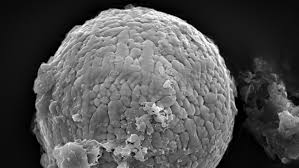
LONDON: Each year, more than 3,000 tonnes of space dust fails to burn up in our planet’s atmosphere and falls instead to Earth’s surface.
These micrometeorites are just a few microns in diameter, but scientists say that embedded in the fossilised specks of this extraterrestrial debris are chemical clues that suggest Earth’s upper atmosphere had almost as much oxygen in it 2.7 billion years ago as it does today.
“We’ve found a way to sample a part of the ancient Earth that we’ve never been able to investigate before,” said Andrew Tomkins, a geologist at Monash University in Melbourne. “And we can show that the upper atmosphere 2.7 billion years ago was oxygen-rich compared to the lower atmosphere.”
The finding, published Wednesday in Nature, is surprising because other lines of evidence strongly suggest that there was essentially no oxygen in the lower atmosphere at that time.
“It is a truth almost universally acknowledged that Earth’s atmosphere before about 2.5 billion years ago had little or no free oxygen, “ wrote Kevin Zahnle of Nasa Ames Research Centre and Roger Buick of the astrobiology program at the University of Washington, in an independent analysis of the study.
Tomkins, who led the research, said he and his team were surprised by the findings as well.
“Geologists are generally familiar with the evidence that the early Earth’s atmosphere contained no oxygen,” he said. “But all of the previous observations relate to lower levels of the atmosphere. Nobody had found a way to sample the upper atmosphere before.”
The group did not initially set out to learn about the upper atmosphere of ancient Earth. Instead, the plan was to search for the oldest micrometeorites ever found, and then use them to look at how much space dust rained down on Earth billions of years ago compared with today.
“Scientists think that the flux was much higher early in Earth’s history, but haven’t got much to go on other than counting craters on the moon and other planets, and a bit of mathematical modelling,” Tomkins said.
But once the team actually got its hands on micrometeorites embedded in 2.7-billion-year-old rock deposits in Western Australia, the trajectory of their research changed.
“Once we saw that they had been metal particles that had become oxidised during atmospheric entry, I realized that they represented a sample of the Earth’s upper atmosphere and we refocused the project onto that topic from there,” Tomkins said.
The authors explain that while fast-moving bits of space dust burn up in Earth’s atmosphere and become shooting stars, those that are moving more slowly often don’t evaporate. Instead, the sand-sized particles of debris that hit the Earth at speeds of 12 to 70km per second get heated to melting temperature at the top of Earth’s atmosphere and then cool down very quickly — all in a matter of a few seconds.
But they are still able to accumulate oxygen from the upper atmosphere during their molten phase because chemical reactions go much faster at high temperatures.
“That’s why they sample a specific range of altitude — they stop being oxidised once they cool down,” Tomkins said.
Using cutting-edge microscopes, the team examined 11 of the 60 ancient micrometeorites it had uncovered and found that most of them had once been particles of iron that had turned into the iron oxide minerals magnetite and wustite.
In order for that chemical reaction to happen, computer models suggest that there had to be almost as much oxygen in the upper atmosphere as there is now.
The authors say their results do not challenge previous findings that the lower atmosphere had almost no oxygen 2.7 million years ago, long before plants began pumping it into the air. It only affects the chemical makeup of the upper atmosphere, where oxygen can be created by photolysis — when carbon dioxide is split by sunlight into carbon monoxide and oxygen.
“It turns out that atmospheric chemists actually predicted that the atmosphere would be relatively oxygen-rich at high altitudes,” Tompkins said.