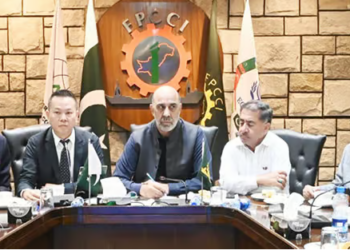
LAHORE: The Businessmen Panel (BMP) of the Federation of Pakistan Chambers of Commerce and Industry (FPCCI) on Sunday termed a sharp rise in oil prices before Eidul Fitr unjustified, calling it totally destructive and dangerous for the trade and industry, which was already stuck in the quagmire of hyperinflation and facing exceptionally high cost of production.
FPCCI’s Businessmen Panel (BMP) chairman Mian Anjum Nisar, who is also the former president of the FPCCI, observed that the businessmen totally reject further jump in petroleum products’ rates for the second fortnight in-a-row ahead of Eid, which is likely to be celebrated at the end of this week, stating the move would further hinder economic activities, as the massive hike in prices of petroleum products and electricity tariff has already jolted the trade and industry amidst record high inflation.


It is unfortunate that the the government has again jacked up the prices of petrol and kerosene oil by Rs10 per litre and Rs5.78 per litre with effect from April 16, 2023, in a fortnightly review of petroleum prices. Presently, the government is charging Rs 50 per liter petroleum levy (PL) on both petrol and high speed diesel (HSD) and zero general sale tax (GST) to meet one of the conditions of the IMF.
The new ex-depot price of petrol will be now be Rs 282 per litre instead of Rs 272 per litre following increase of Rs 10 per litre. The price of kerosene oil has also been raised by Rs 5.78 per litre.
Mian Anjum Nisar, quoting a report, warned that the inflation is projected to further rise to 29.5 per cent in the fiscal year 2023 due to higher energy and food prices and the weaker Rupee while the real GDP growth was expected to slow sharply to 0.4 percent in the fiscal year 2023 reflecting corrective tighter fiscal policy, flood impacts, high inflation, high energy prices and import controls.
He said that the economy is under stress with low foreign reserves and high inflation. Activity has fallen with policy tightening, flood impacts, import controls, high borrowing and fuel costs, low confidence, and protracted policy and political uncertainty. Despite some projected recovery, growth is expected to remain below potential in the medium term.
With dampened imports, the current account deficit is projected to narrow to 2pc of GDP in the fiscal year 2023 but widen to 2.2pc of GDP in the fiscal year 2025 as import controls ease. The fiscal deficit is projected to narrow to 6.7pc of GDP in the fiscal year 2023 and further over the medium term as fiscal consolidation takes hold.
The macroeconomic outlook is predicated on the completion of the IMF program, sound macroeconomic policy, continued structural reforms and adequate external financing.
Referring to the report, he further added that agricultural output was also expected to contract for the first time in more than 20 years due to last year’s catastrophic floods.
Industry output is also expected to shrink with supply chain disruptions, weakened confidence and higher borrowing costs and fuel prices. The lower activity is expected to spill over to the wholesale and transportation services sectors, weighing on services output growth.
He said that that poverty would inevitably increase with pressures from weak labour markets and high inflation, warning that further delays in external financing, policy slippages, and political uncertainty poses significant risks to the macro poverty outlook for the country.
The lower activity is expected to spill over to the wholesale and transportation services sectors, weighing on services output growth. Furthermore, distortive policy measures, including periods of exchange rate caps and import controls, delayed the IMF program and contributed to creditworthiness downgrades, lower confidence, high yields, interest payments and the loss of access to international capital markets.
He noted that in recent developments, official remittance inflows fell by 11.1pc, partly due to the exchange rate cap that made informal non-banking channels preferable.
Key risk is the non-completion of the IMF program due to policy slippages and the non-materialization of expected financing. Additional risks include political instability, deterioration of domestic security and external economic conditions and financial sector risks associated with revaluation losses, liquidity shortages, and high sovereign exposure.
Despite an inevitable increase in the prices that will unleash a strong wave of inflation, the coalition government remains short of clinching a deal with the International Monetary Fund that still requires an agreement. On the other hand the NEPRA has increased the electricity rates mainly on account of fuel prices, capacity cost payments and the impact of rupee devaluation against the US dollar.
He condemned the National Electric Power Regulatory Authority’s decision to increase electricity tariffs, stating that the burden of power theft, mismanagement, and inefficiencies cannot be shifted to consumers on the pretext of fuel adjustment.
Anjum Nisar stated that the constant increase in power tariffs on the pretext of fuel adjustment had increased electricity prices and added to the already high cost of trade and industry.
Seeking comparable energy tariffs for domestic industries in order to capture the global market, he stated that due to high electricity rates, power theft became rampant as the tariff was unaffordable to consumers.