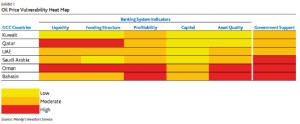
DOHA: Reduced oil revenues are leading to a more challenging funding environment in the GCC. With the regional banks’ annual deposits growth slowing significantly, from around 10% during 2014 to around 3% during 2015, the liquidity is expected to remain tight over 2016, Moody’s Investors Service noted yesterday.
“Low oil prices have pressured operating conditions for banks across the GCC countries, with real non-oil economic growth having to an average of around 3% over 2016 from around 6% in 2014. The impact of low oil prices on GCC banks’ stand-alone profiles has so far been most acute in terms of more challenging liquidity conditions, reflecting increasing government borrowings, reduced deposit inflows and rising interest rates”, Moody’s report said.

Qatar is still expected to deliver solid non-oil economic growth in the 8 percent range driven by continued infrastructure investments that provide stable growth prospects for 2016.
However, the banks have experienced a significant slowdown in overall deposit growth, to 6 percent over 2015 from above 20 percent during 2012-13. Moody’s expects credit growth to fall to a more moderate 8% over the next 12 months from 15 percent levels previously. The resultant funding gap is already pressuring liquidity and driving banks to compete for deposits and forcing them to seek longer-term, but costlier, market funding.
Across the region “funding and liquidity are becoming expensive, reflecting increasing government borrowing and reduced deposit inflows and rising interest rates. Although liquid asset buffers, remain sound, these trends are driving up market funding levels of local banks, increasing their overall cost of funds and dampening profitability”.
Moody’s expects elevated liquidity pressures, particularly in Qatar, given the still very high proportion of government and related deposits (around 33%) in the system, which has already declined by around 8% during 2015. This liquidity pressure is exacerbated by the high credit growth expected, owing to very high levels of public spending needed for the 2022 World Cup, as well as the significant slowdown in overall deposit growth. Consequently, Qatar banks’ loan-to-deposit ratio has already increased beyond 100 percent and liquidity levels have declined to 26% to total assets as of December 2015 from 31% as of December 2012.
For the banking systems of Qatar and Kuwait Moody’s continues to expect a modest impact over the next 12 months given their very low fiscal breakeven oil prices and large reserve buffers. However, between the two systems, Kuwait is the least affected, as credit growth has already been amongst the lowest in the GCC at around 7% during 2015. Credit growth in Qatar is expected to reduce healthy levels of around 8 percent over the next 12 months, but down from 15 percent during 2013.
The GCC’s confidence-sensitive real-estate sector remains a significant part of both the economy and the banking system. This sector contributes around 10% to 30% of GDP and 15% to 30% of banking system sector exposures. This sector was a key source of asset quality pressures for regional banks during the global financial crisis when property prices collapsed.
However, real estate risks in Qatar are moderate, where higher future volatility is expected to be reduced as a result of macro prudential measures taken by the regulator as well as the high demand generated around the spending related to 2022 World Cup.