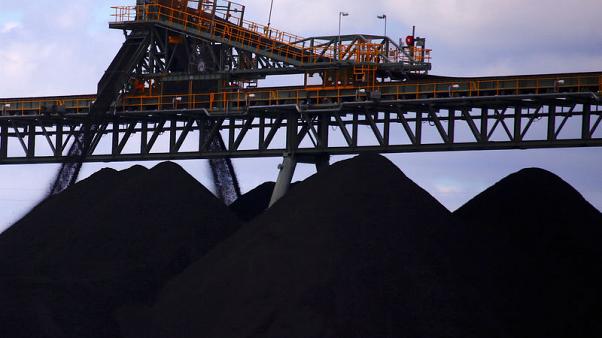
SINGAPORE (Reuters) – Australian thermal coal prices this week registered their biggest weekly fall since the financial market turmoil of a decade ago as demand plunged with the end of winter and amid worries over the strength of the global economy.
Coal prices for prompt loading at Australia’s Newcastle terminal have lost almost 20 percent since last Friday, dropping to $72 per tonne, their lowest since May 2017, and marking the steepest weekly decline since the global financial crisis of 2008/2009.

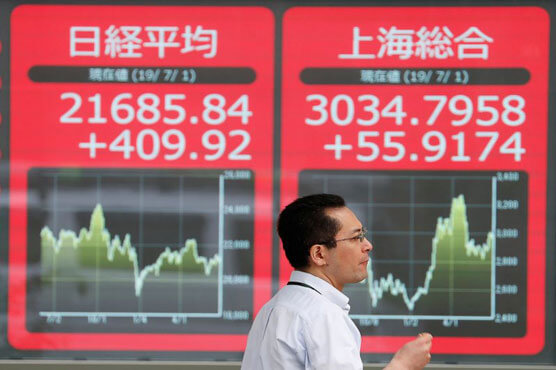
Coal has slumped by 40 percent from a mid-2018 peak of more than $120 per tonne.
This week’s plunge comes just days after Australian miners and Japanese power utilities settled a fixed delivery price for April 2019 to March 2020 of $94.75 per tonne.
“Many times in the past, we’ve seen Newcastle soften after the April-March negotiations have been finalised,” said Pat Markey, managing director of Singapore-based commodity consultancy Sierra Vista Resources.
Japan is the biggest buyer of Australian thermal coal. The contract to March 2020 was 14 percent lower than the price for a year-long deal for supplies through September this year.
Traders said the slump comes amid a slowdown in industry activity in Asia, Europe and North America that has triggered fears of a global recession.
The coal slump also follows a 60 percent crash in Asian prices for liquefied natural gas (LNG), coal’s most direct competitor as a power generation fuel.
Graphic: Asian physical coal & LNG prices (https://tmsnrt.rs/2CWRQD1)
DEMAND FROM BIGGEST IMPORTERS FALLS
Trade data on Refinitiv Eikon showed a sharp weekly fall in thermal coal imports from Australia’s biggest buyers of China, India, Japan, South Korea and Taiwan.
These countries’ overall imports fell to 11.8 million tonnes from 16.1 million tonnes between weeks 12 and 13 of this year.
In India, coal imports have slowed despite strong demand as domestic output rose from Coal India, the world’s biggest coal miner.
Coal India’s fourth-quarter coal production last year rose 2.6 percent from a year earlier to 155.97 million tonnes, and output rose further in the first quarter of 2019 as the company re-opened previously closed mines.
European coal demand has fallen with the end of the heating season but also as its biggest economy and coal user, Germany, teeters on the edge of a recession.
European benchmark API2 2020 coal futures have lost almost a third in value since their 2018 peak, to a close of $72 per tonne on Thursday.
Graphic: European coal futures (https://tmsnrt.rs/2CZcnXv)
Adding to the woes of Australian coal miners has been a sharp decline in Chinese imports as customs have been slow to clear Australian cargoes.
Chinese imports of Australian thermal coal have fallen from 2 million tonnes in January, to around 1.3 million tonnes in March, according to Refinitiv Eikon shipping data.
The slump comes partly because of high coal inventories in China, the world’s biggest coal importer.
Refinitiv coal analyst Vishal Thiruvedula estimated that stocks at the main Bohai seaports of Caofeidian, Qinhuangdao and Jingtang in Northern China have risen by over 2 million tonnes since this time last year, to 16.2 million tonnes in March.
Given the end of the peak demand winter season and the onset of wet spring weather, these high stocks are unlikely to be drawn down soon, he said.
Thiruvedula said an increase in Chinese hydro power production due to higher rainfall in the coming weeks would also result in “reduced coal burn for April to June”.