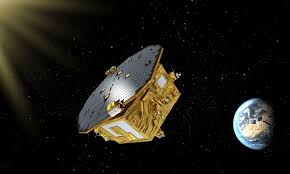
LONDON: It has taken just two months of space-based experimentation for scientists and engineers to know that the European Space Agency’s technology testing mission LISA Pathfinder is far exceeding its design requirements.
The results mean that Europe could now begin building a mission to detect gravitational waves from space.


Gravitational waves hit the headlines earlier this year when scientists from the Laser Interferometer Gravitational-wave Observatory (LIGO), based in the United States, detected these minuscule ripples for the first time.
This detection, coupled with the unprecedented success of LISA Pathfinder, led Stefano Vitale, LISA Pathfinder Primary Investigator, University of Trento to call 2016 an “Annus mirabilis” at today’s press conference. European Space Agency’s gravity probe leaves UK for final tests before launch
Gravitational waves are a prediction of Einstein’s General Relativity. In this century-old theory, Einstein describes gravity as an invisible landscape of contours. Accelerating objects produce oscillations in this landscape, which are the gravitational waves. They propagate outwards like ripples on a pond.
However, they are minuscule, causing disturbances of no more than a thousandth the width of an atomic nucleus. This made Einstein doubt whether they would ever be measured.
LISA Pathfinder was supposed to take a step towards the necessary sensitivity to do this in space. However, the engineering is so good that it has virtually crossed the finish line.
At the heart of the mission are two metal cubes. Each weighs 2kg and has been hewn from a €200,000 ingot of gold-platinum alloy. Today, the European Space Agency announced that the spacecraft has succeeded in isolating these ‘test masses’ from every other force in the Universe except gravity.
This test could not be performed on Earth because the cubes had to float freely inside the spacecraft. The position between the two cubes is measured by a laser system, which is the key to building a gravitational wave observatory in space.
According to Fabio Favata, Head of the ESA Science Coordination Office, detecting gravitational waves is the equivalent of developing microphones for space. Until this year, all information had come from telescopes that look into the universe.
Gravitational wave detection opens up a whole new realms to investigation. For example, colliding black holes emit no light but give out a wealth of gravitational waves. Favata said that detecting such gravitational waves was the equivalent of being in a forest and hearing the animals while not being able to see them.
He also said that the success of the mission was only possible because of European cooperation. ESA chose Airbus in Stevenage, UK, to build the spacecraft.
Now that LISA Pathfinder is working so well, ESA could begin building a full gravitational wave mission. This has come to be referred to generically as LISA for Laser Interferometer Space Antenna (LISA).
At the agency, the name LISA has assumed such redolence of future possibilities that ESA’s Director of Science Johann-Dietrich Woerner admitted at today’s press conference that he even named his first daughter after the mission.
LISA – the mission – would detect different frequencies of gravitational waves than LIGO and other ground-based detectors. For example, from space astronomers could ‘hear’ the formation of galaxies in the early days of the Universe.
A full LISA mission is planned for launch in 2034. It would consist of two or three identical spacecraft flying five million kilometres apart. A recent report by European experts suggested that this time frame could now be brought forward because of LISA Pathfinder’s stunning success.
But Favata warned that certain other technologies, like the laser system to communicate between the spacecraft across those millions of kilometres, needed to be developed. Once ESA was convinced that all technologies were ready, then they would green-light the mission and begin the decade-long process of building LISA.