WASHINGTON: For the first time, scientists have found a giant planet snuggled up against a baby star, a rare discovery offering a new glimpse at how such planets develop.
The “hot Jupiter” planet was found orbiting the star V830 Tau, located about 430 light years from Earth in a star-forming region of the constellation Taurus, says an international team of researchers led by French scientist Jean-François Donati of France’s National Centre for Scientific Research.


The star is just two or three million years old — practically a newborn. For comparison, our own star, the sun, which is still in its prime, is about 4.5 billion years old.
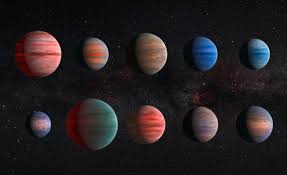
Planets are always younger than their stars, which means that the new hot Jupiter, which has about three-quarters the mass of Jupiter, is also very, very young. Clear to cloudy hot Jupiters
Hot Jupiters are giant planets that orbit close to their host stars, and may represent one per cent of all planets. This image shows an artist’s impression of the 10 hot Jupiter exoplanets described in a 2015 NASA study. (ESA/Hubble & NASA)
And yet, it orbits just 8.5 million kilometres from its host star — about a seventh the distance between the sun and its closest planet, Mercury. Each trip around the star takes it just 4.9 Earth days.
“We didn’t expect this kind of planet so early in the life of a star,” said Elodie Hébrard, a post-doctoral researcher at York University who co-authored the new study, published this week in the journal Nature.
That’s because giant planets are thought to form far from their host star, in a disk of dust and gas that surrounds young stars. V830 Tau is so young that there is still some of that “protoplanetary disk” around its star, said Hébrard, who works with the research group of professor Ray Jayawardhana.
‘We didn’t expect this kind of planet so early in the life of a star.’- Elodie Hébrard, York University
In fact, given what was known about the formation of giant planets, the discovery of the first hot Jupiter in 1995 was a big surprise, Hébrard said.
Since then, many other hot Jupiters have been discovered, and they are now thought to represent about one per cent of all planets. Astronomers have puzzled over how they end up so close to their host stars. Two theories have been proposed:
They get gently pushed toward their star early in life by the planet-forming disk. A more violent interaction with other planets shoves them toward the star much later on.
It was hard to tell which theory was more likely, because up until now, hot Jupiters have only been detected around mature stars. In fact, very few planets at all have been detected around stars that are less than 10 million years old.
The problem is that detecting planets around young stars is very difficult. Large planets close to their stars are often discovered using a technique called Doppler spectroscopy or the radial velocity method.
As the planet orbits the star, the pull of its gravity causes the star to wobble slightly. As it wobbles slightly toward or away from the Earth, the colour of the light from the star as viewed from Earth changes slightly, the way the pitch of an ambulance siren changes depending on whether it’s moving toward or away from you. This is called the Doppler effect.
Few planets have been detected around stars less than 10 million years old. The hot Jupiter is one of two baby planets announced this week in Nature. The other is K2-33b, pictured above, a planet slightly larger than Neptune discovered using the Kepler Space Telescope. ( NASA/JPL-Caltech)
This small colour change is hard to see in the light of young stars because such stars are active and give off intense signals compared to the change that a planet would cause, Hébrard said.
In order to make a potential planetary signal visible in the light of V830 Tau, the researchers borrowed a technique used in medical imaging.
They observed the star using devices called spectropolarimeters on the 3.6-metre Canada France Hawaii Télescope (CFHT) on Mauna Kea and the 2-metre Téléscope Bernard Lyot (TBL) in the French Pyrenees mountains. They used the measurements to create a map of the light and dark spots on the stars as it rotates, which allowed them to subtract off those variations and see the much smaller variations caused by the planet.
The discovery of the planet around such a young star suggests that at least some of the time, the migration of hot Jupiters toward the star happens very early in planet formation and they’re likely pushed by the protoplanetary disk.
The planet is one of two young planets discovered around young stars this week. The other, called K2-33b, was discovered using the Kepler Space Telescope’s K2 mission, NASA announced in another paper in Nature. That planet is five to 10 million years old, 50 per cent larger than Neptune (smaller than the hot Jupiter), and also orbits its star very closely. The NASA team suggests it could have migrated from farther out, or may even have formed right where it is now.