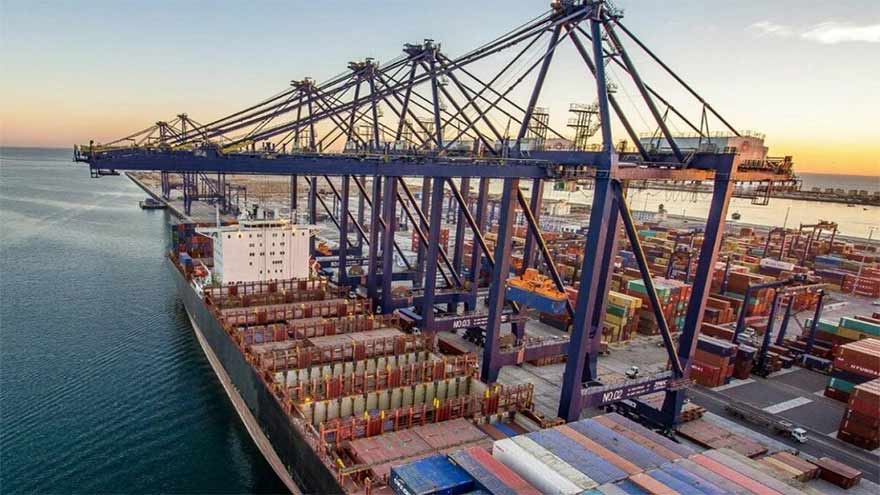
KARACHI: A newly deepened cargo terminal at Karachi port can now accommodate ships carrying twice as much cargo as before, potentially saving the country’s traders more than $150 million annually in freight costs, its chief executive told media this week.
The development comes as Pakistan seeks to modernize its ports, attract foreign investment and position itself as a trade gateway for landlocked Central Asian economies. Disruptions to shipping routes in the Gulf have also created opportunities for Pakistani ports to attract cargo destined for regional markets.


The upgrade was carried out at Karachi Gateway Terminal Multipurpose Limited (KGTML), which handles bulk commodities and general cargo and is operated by a joint venture involving Abu Dhabi-based AD Ports Group, a major international ports and logistics company, and UAE-based Kaheel Terminals.
Khurram Aziz Khan, chief executive of KGTML and the adjoining Karachi Gateway Terminal Limited (KGTL), which handles container cargo, said the completion of dredging — the removal of sediment from the seabed to deepen shipping channels and berths — had doubled the cargo-carrying capacity of vessels the bulk terminal could accommodate.
“Prior to that dredging, our port was only equipped to handle Handymax vessel which means a 60,000-ton vessel at max,” Khan said in an interview.
“Now with our dredging completed already, we have the ability to handle up to 120,000 tons,” he said. “We are equipping ourselves to handle post-Panamax vessel.”
Post-Panamax refers to ships larger than those designed to pass through the Panama Canal’s original locks, allowing shipping companies to transport greater volumes of cargo on individual voyages.
Khan said the terminal’s ability to accommodate larger vessels, combined with faster turnaround times and more efficient cargo handling, could reduce freight costs by 25-35 percent.
He estimated that savings could exceed $50 million next year if just 20 percent of bulk cargo volumes gradually shifted to larger vessels.
“This will gradually increase and crossing $150 million per annum,” he said.
The projected savings would be significant for Pakistan, which relies on foreign exchange to finance imports and meet external debt obligations. However, the estimates depend on shipping companies shifting sufficient cargo to larger vessels and realizing the expected efficiency gains.