

Customs Today
  • Home
  • Islamabad
  • Karachi
  • Lahore
  • National
  • Transfers and Postings
  • Chambers & Associations
  • Business
No Result
View All Result
Customs Today
  • Home
  • Islamabad
  • Karachi
  • Lahore
  • National
  • Transfers and Postings
  • Chambers & Associations
  • Business
No Result
View All Result
Customs Today
No Result
View All Result
Home Science & Technology Science

Larger galaxy starts producing stars faster when it merges with a smaller galaxy

byCustoms Today Report
14/07/2015
in Science, Science & Technology
Share on FacebookShare on Twitter

You might also like

Tesla driverless system to use updated radar technology

12/09/2016

Apple to develop its own self-driving technology

10/09/2016

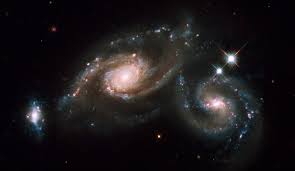
CANADA: People often talk about two worlds colliding, but what about two galaxies? It turns out that scientists now know what happens when a large galaxy crashes into a smaller one.
According to a new study of more than 20,000 merging galaxies, the larger galaxy starts producing stars faster when it merges with a smaller galaxy, while the smaller galaxy ends up slowing star production. Stellar!
Scientists aren’t quite sure why this happens, though it may have to do with large galaxies’ ability to strip away gas — which is fuel for star formation — from its puny companions. Just check out the video above, describing the study.
“When two galaxies of similar mass collide, they both increase their stellar birth rate,” the study’s lead author Dr. Luke Davies, an astrophysicist at The University of Western Australia node of the International Centre for Radio Astronomy Research (ICRAR), said in a written statement. “However when one galaxy significantly outweighs the other, we have found that star formation rates are affected for both, just in different ways… Investigating such cosmic collisions lets us better understand how galaxies grow and evolve.”
Our galaxy — the Milky Way — might experience a merger first-hand as it’s on a collision course with its hefty neighbor, the Andromeda galaxy. According to Davies, Andromeda is moving toward us at more than 200,000 miles per hour.
But don’t worry, that collision is a few billion years away. For now, this new research may help us to better understand star formation in other galaxies near, and far.

Related Stories

Tesla driverless system to use updated radar technology

byCT Report
12/09/2016

WASHINGTON: Electric carmaker Tesla announced Sunday it was upgrading its Autopilot software to use more advanced radar technology. In a...

Apple to develop its own self-driving technology

byCT Report
10/09/2016

SAN FRANCISCO: Apple may not become an automaker, but it still wants to develop its own self-driving technology. The iPhone-maker's...

NASA spots slowest known magnetar

byCT Report
10/09/2016

WASHINGTON: Astronomers have found evidence of a magnetar - magnetised neutron star - that spins much slower than the slowest...

‘YouTubers’ outshining old-school television

byCT Report
09/08/2016

SAN FRANCISCO: A media revolution is taking place, and most people over 35 years of age aren’t tuned in. Millennial...

Next Post

Buckinghamshire stars in top 10 of UK start-up businesses in 2015

  • Terms and Conditions
  • Disclaimer

© 2011 Customs Today -World's first newspaper on customs. Customs Today.

No Result
View All Result
  • Transfers and Postings
  • Latest News
  • Karachi
  • Islamabad
  • Lahore
  • National
  • Chambers & Associations
  • Business
  • About Us

© 2011 Customs Today -World's first newspaper on customs. Customs Today.