MINDANAO: The limited capacity of seaports in Mindanao restricts the southern island’s potential role as a major trading point for the Philippines within the Association of South East Asian Nations’ (ASEAN) integrated economy, according to Socioeconomic Planning Secretary Emmanuel F. Esguerra.
“Mindanao is still faced by current issues on sea transport such as limited capacity of its seaports,” said Mr. Esguerra, also the National Economic and Development Authority (NEDA) director-general, during the Mindanao Shipping Conference 2016 held here Wednesday.


He cited the inadequacy of, or absence of, berthing structures, transit or cargo shed areas for non-containerized cargo, container yards for containerized cargo, and passenger terminal buildings.
Esguerra also said there is a need to expand existing sea linkages or establish new ones, particularly the routes between Zamboanga and Sandakan, Malaysia; Davao/General Santos and Bitung, Manado, Indonesia; Zamboanga and Muara, Brunei; and Tawi-Tawi and Tarakan, Indonesia.
The limited capacity of Mindanao’s ports was also cited by European Union (EU) Ambassador to the Philippines Franz Jessen during his visit to the city early this year as a deterrent to the influx of EU investments in the country’s southern area.
Jessen said the EU is looking at Davao City as a possible investment area after the completion of the free trade agreement between the EU and the Philippines.
Edwin O. Banquerigo, Department of Trade and Industry director for Davao City, said there are plans to develop the Davao Region as a transshipment hub given its strategic location within the Brunei, Indonesia, Malaysia, Philippines-East ASEAN Growth Area, but the infrastructure will first have to be put in place.
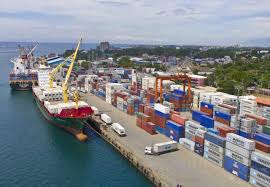
He noted that most of the ships docking at Sasa Port, a government-owned facility, are feeder vessels with an average capacity of 300-500 20-foot equivalent units (TEU) while the mother boats at the port of Singapore are capable of handling 1,000 TEU.
The government’s plan to bid out the Sasa Port modernization project under the public-private partnership scheme has been met by opposition from the local government and business sector for allegedly being overpriced.
There is also a proposal to develop a mixed-used complex, including an international seaport facility, in a reclaimed area covering the Sta. Ana Wharf in Davao City.
Meanwhile, Esguerra also cited the need to review existing domestic cargo rates in Mindanao.
“There is also a need to reduce domestic cargo rates as rates in Mindanao are more expensive than foreign cargo rates,” he said.
In Cebu, where the similar Visayas Shipping Conference 2016 was held Thursday, Cebu Port Authority General Manager Edmund C. Tan said the new Cebu international container port may start construction by August this year if it gets the go signal soon from the NEDA Board.
Tan said NEDA is currently waiting for “the submission of requisite documents for the said project” from the Department of Transportation and Communications “to facilitate NEDA Board-ICC (Investment Coordination Committee) processing and approval.”
These documents include the feasibility study, which was completed in July 2015 and ICC project evaluation forms.
The feasibility study on the new Cebu port, done by Korean experts, pointed to a location in Tayud, Consolacion as the project site. Among the study’s recommendations is to source funding from Korea’s Economic Development Cooperation Fund as the project, which has an estimated project cost of P10 billion, has poor financial viability.