DOHA: Amid persistently low oil prices and an economic slowdown, increasing liquidity pressure is evident in the GCC’s financial sectors. Growing pressure and challenging conditions are evident in rising loans to deposits ratios (LDR), higher interbank rates, and increasing government borrowings.
According to SICO Investment Bank’s latest research note on GCC economy, deposit growth in the GCC banks started decelerating from mid-2013 amid significant drop in oil prices. The growth in GCC deposits slowed down to (+3.6 percent) growth in 2015 from 10.2 percent growth in 2015 where as the deceleration in credit growth was slower reaching 9.6 percent in 2015 from 10.1 percent in 2014.

Lower deposit inflows in 2015 were driven both by lower growth in private sector deposits and a decline in public sector deposits. As at 2015, public deposits in the GCC declined by (-2.8 percent) compared to a 8.5 percent growth in 2014; while the growth of GCC private sector deposits slowed down to 4.6 percent in 2015 from 9.7 percent in 2014.. It is important to note that total public sector deposits account for 23 percent of total deposits in the GCC.
In the note sent to The Peninsula, the SICO analyst said: “Following the US Federal Reserve’s interest rate hike, Saudi Arabia and other GCC members increased interest rates for the first time since 2009. Additionally, tightening liquidity accompanied by increasing competition and demand for lending opportunities, pushed GCC interbank rates up.”
Money supply growth, specifically M2 growth, has followed a downward trend in the GCC since 2014, reflecting the degree of liquidity tightening and consumption. M2 alone is not a sole indicator of a liquidity squeeze in the financial sector, but along with a variety of other factors, a slowdown in M2 raises concern about lower liquidity in the market.
The latest statistics published by GCC central banks point to rising liquidity concerns with increasing public sector deposit outflow and a significant slowdown in private sector deposit inflow. “Tighter liquidity conditions present higher risk to the financial sectors in the GCC adversely affecting asset quality, driving LPS upwards, and ultimately increasing the cost of risk. Additionally, tighter liquidity conditions have also adverse effects on the profitability of the banking sector in the GCC as costs of funds are pushed upwards.”, SICO analysts said.
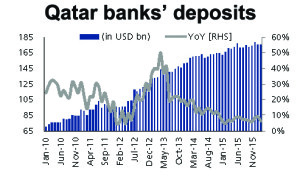
In fact, GCC banks, including in Qatar, started the year 2016 with increasing signs of liquidity pressure, as deposits growth across most GCC banking sectors declined on a month-on-month (MoM) basis as at January and February. The outflow in deposits growth continued within the major GCC banking sectors, with total deposits declining by 0.8 percent MoM in Saudi Arabia, and 0.3 percent MoM in Qatar in the month of February.
As the deposit outflow continues to accelerate while loan growth decelerates at a much slower pace, loans to deposits ratios of most GCC banking sector is being driven upwards., reflecting prevailing tighter liquidity. Qatar’s LDR was the highest in January 2016 at 118 percent compared to 109 percent in January 2015, increasing to 120 percent in February 2016.