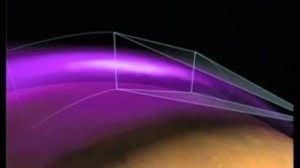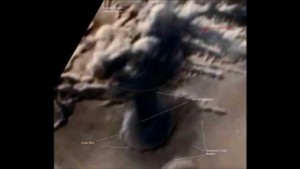


PARIS: In the latest surprising discovery, NASA’s Mars Atmosphere and Volatile Evolution (MAVEN) spacecraft has for the first time observed an unexplained high-altitude dust cloud and aurora lights reaching deep into the Martian atmosphere.
The dust was found at orbital altitudes from about 93 miles (150 kilometers) to 190 miles (300 kilometers) above the surface. The source of the dust remained a mystery, although it posed no danger to the MAVEN and other spacecraft orbiting Mars.
The cloud was detected by the spacecraft’s Langmuir Probe and Waves instrument and was found to be most dense at lower altitudes. The dust may have come from Phobos and Deimos, the two moons of Mars, it may have moved in on the solar wind, or it could be debris from comets orbiting the sun. Another theory is that the dust wafted up from the atmosphere.
“If the dust originates from the atmosphere, this suggests we are missing some fundamental process in the Martian atmosphere,” said Laila Andersson of the University of Colorado’s Laboratory for Atmospherics and Space Physics, Boulder, Colorado.
MAVEN’s Imaging Ultraviolet Spectrograph observed the aurora spanning Mars’s northern hemisphere on Dec. 20. Scientists nicknamed it “Christmas lights.” Aurorae, known on Earth as northern or southern lights, are caused by energetic particles like electrons crashing down into the atmosphere, causing gases there to glow.
“What’s especially surprising about the aurora we saw is how deep in the atmosphere it occurs – much deeper than at Earth or elsewhere on Mars,” said Arnaud Stiepen, IUVS team member at the University of Colorado. “The electrons producing it must be really energetic.”
Scientists believe the source of the particles was the sun. MAVEN’s Solar Energetic Particle instrument detected a huge surge in energetic electrons at the onset of the aurora.
Billions of years ago, Mars lost a global protective magnetic field, so solar particles can directly strike the atmosphere. The electrons producing the aurora have about 100 times more energy than you get from a spark of house current, so they can penetrate deeply in the atmosphere.

Karachi Port sets 138-year cargo handling record
KARACHI: Pakistan's maritime sector has achieved a major milestone as Karachi Port set a new record in its 138-year history...