

MEXICO: When destined to stay close to Earth, spacecraft often must withstand the hazards of our space environment. They can be exposed to regular radiation showers from the sun and – if the space weather is particularly intense, such as when the giant clouds of solar material that erupt off the sun called coronal mass ejections pass by – they can go into safe mode.
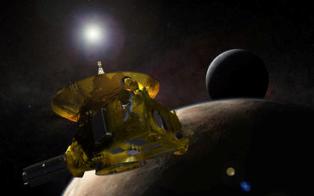
However, because there is less data available, we know less about what a spacecraft endures further away. So, as NASA’s New Horizons mission reaches a historical milestone on its journey to explore the outer solar system, scientists have an all new question: What is the space environment like at Pluto?
A few months before New Horizons was due to reach this icy dwarf planet, a community of scientists came together to determine just what kind of a environment the mission would experience during its historic flyby. While the simulations aren’t 100% conclusive, this first ever attempt to characterize space weather conditions so far from our own home opens the door to better protecting our spacecraft – and eventually humans—as we continue to explore the solar system and beyond.
To attempt to map what surges of particles are passing by Pluto, the Community Coordinated Modeling Center, or CCMC, at NASA’s Goddard Space Flight Center in Greenbelt, Maryland, sought input from space weather scientists around the nation. The CCMC houses numerous software models to help scientists with their research and also to enable improved space weather forecasting.

Karachi Port sets 138-year cargo handling record
KARACHI: Pakistan's maritime sector has achieved a major milestone as Karachi Port set a new record in its 138-year history...