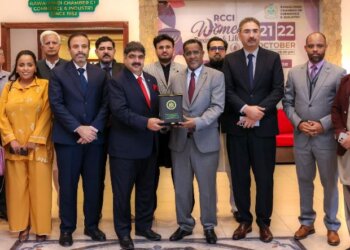
LAHORE: The Pakistan-China Joint Chamber of Commerce & Industry (PCJCCI) underscored the vast potential of Punjab’s food processing sector as a cornerstone for bilateral economic collaboration and export growth under the China–Pakistan Economic Corridor (CPEC) during a think-tank session held at PCJCCI Secretariat.
PCJCCI President Nazir Hussain stressed Punjab’s unmatched agricultural capacity, inviting deeper Chinese investment and technology transfer to strengthen value-addition and foreign exchange earnings. He added that Punjab cultivates 57 per cent of Pakistan’s total cropland — over 17 million hectares — which supports 80 per cent of the nation’s wheat and 95 per cent of citrus, 82 per cent of guava, and 66 per cent of mangoes.


Joint chamber’s Senior Vice President Brig (retd) Mansoor Saeed Sheikh said that the province contributes nearly 19 per cent to national GDP, making its economy the largest of any Pakistani region. He highlighted that Punjab’s food processing industry stands on the cusp of a transformative expansion — leveraging its massive raw agricultural output, strategic location, CPEC’s infrastructural momentum, and access to Chinese technology and capital. With targeted policy support and international certification standards, the sector is poised to drive job creation, rural prosperity, and export diversification.
Zafar Iqbal, PCJCCI Vice President, stressed that more than 2,300 Chinese firms are operating across CPEC-linked sectors in Pakistan, signaling strong investor confidence. He said that CPEC Phase-II includes robust cooperation in food processing, post-harvest handling, cold storage, and mechanisation. He disclosed that a Chinese agritech group, Sichuan Litong Food Co., plans a 1,000-acre pepper pilot in Multan with local processing plants in Lahore and Multan, targeting a $3 billion annual trade in processed food by 2026.