

CANADA: A team of physicists from the University of Chicago have discovered how to make atoms do their bidding.
The group, who published an article with their findings in the journal Physical Review Letters, have demonstrated that they can use a laser to control how atoms behave. Depending on the wavelength at which they set their laser, they could control whether the atoms attracted each other, or repelled each other, like magnets.
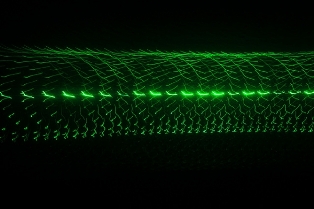
The cesium atoms must first be cooled to a temperature just a hair above absolute zero, the temperature at which particles pretty much stop moving entirely. Then, the researchers use a laser turned to a special frequency (which they call “magic”), and aim it at the atoms. Normally, these atoms would repel each other when they collide, but under the spell of the laser (a.k.a. magic wand), they instead begin to be attracted to each other. It’s sort of the atomic equivalent of Love Potion #9.
By switching the wand between different settings, the physicists could make the atoms attract or repel each other, or even pass through each other virtually unnoticed.
“This realizes a goal that has been pursued for the past 20 years,” said Cheng Chin, professor in physics at the University of Chicago, who led the team.
Many scientists shirk at the idea of calling anything “magic,” because it has a connotation of meaning beyond the grasp of science. But these physicists show that, as Arthur C. Clarke said, “Any sufficiently advanced technology is indistinguishable from magic.” Coincidentally, the researcher who first came up with the idea to manipulate atoms in this way, and who refers to it as “magic,” is named Logan Clark.
Of magic, he said “Generally it is used to refer to a wavelength at which two effects cancel or are equal, in particular when this cancellation or equality is useful for some technological goal.”

Karachi Port sets 138-year cargo handling record
KARACHI: Pakistan's maritime sector has achieved a major milestone as Karachi Port set a new record in its 138-year history...