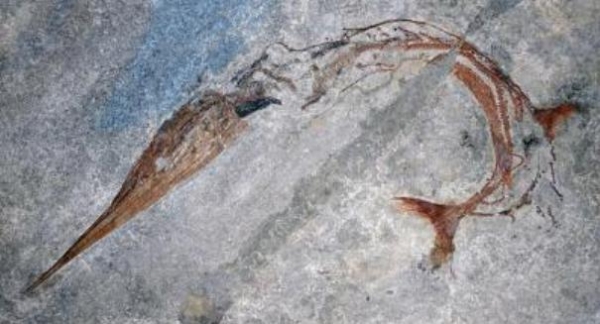
WASHINGTON: A 300-million-year–old fish that looks like a little shark could see its prehistoric environment in colour, palaeontologists declare.
The fossilied eye of the acanthodii fish is the earliest case of colour vision ever discovered in an animal.
It is hoped that the discovery will enable scientists to pinpoint exactly when colour vision first evolved.
‘This fossil fish eye is the first evidence to suggest animals saw in colour as early as 300 million years ago,’ Professor Andrew Parker, Research Leader at the Natural History Museum said.
‘It is the first case of colour vision in an ancient, extinct animal, proving colour vision existed a long time before the Jurassic period.’ This period stretched from approximately 200 to 146 million years ago.‘These are both in the retina of a modern human and animal eye to enable colour vision.’
Cones are structures in the eye that are designed to absorb particular wavelengths of light and transmit them to the brain.Most people have three types of cones, which are tuned to wavelengths of red, green and blue.
Professor Parker added: ‘We can now use these techniques to examine colour pigments in other ancient animals, bringing us closer to the time when colour vision first evolved.’
Scientists from the museum in London and Kumamoto University in the Kyushu region of Japan, scanned the tissues in the fossilised eye of Acanthodes bridgei using an electron microscope.
Further chemical analysis on the fossil showed evidence of cone cells and rods in the retina, according to the study, which was published in Nature Communications.
Parts of the visual system are not usually preserved in the fossil record because the soft tissue of the eye and brain decay rapidly after death, making the discovery particularly rare.
Acanthodiforma were filter feeders, with no teeth in the jaw. Many paleonthologists consider that the acanthodians were close to the ancestors of bony fishes.
Although their interior skeletons were made of cartilage, a bonelike material developed in the skins of these fish, in the form of closely fitting scales.
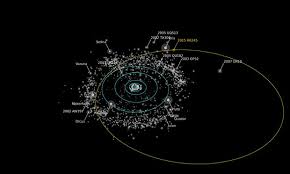
Astronomers discover distant dwarf planet beyond Neptune
LONDON: A dwarf planet half the size of Britain has been found tumbling through space in the most distant reaches...