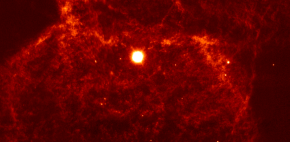


NEW YORK: Fast-moving magnetic waves emanating from a distant supermassive black hole undulate like a whip whose handle is being shaken by a giant hand, according to a new study using data from the National Radio Astronomy Observatory’s Very Long Baseline Array. Scientists used this instrument to explore the galaxy/black hole system known as BL Lacertae (BL Lac) in high resolution.
“The waves are excited by a shaking motion of the jet at its base,” said David Meier, a now-retired astrophysicist from NASA’s Jet Propulsion Laboratory and the California Institute of Technology, both in Pasadena.
The team’s findings, detailed in the April 10 issue of The Astrophysical Journal, mark the first time so-called Alfven (pronounced Alf-vain) waves have been identified in a black hole system.
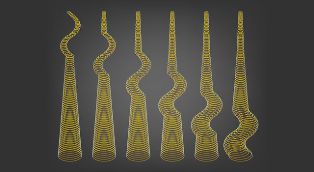
Alfven waves are generated when magnetic field lines, such as those coming from the sun or a disk around a black hole, interact with charged particles, or ions, and become twisted or coiled into a helical shape. In the case of BL Lac, the ions are in the form of particle jets that are flung from opposite sides of the black hole at near light speed.
“Imagine running a water hose through a slinky that has been stretched taut,” said first author Marshall Cohen, an astronomer at Caltech. “A sideways disturbance at one end of the slinky will create a wave that travels to the other end, and if the slinky sways to and fro, the hose running through its center has no choice but to move with it.”
A similar thing is happening in BL Lac, Cohen said. The Alfven waves are analogous to the propagating sideways motions of the slinky, and as the waves propagate along the magnetic field lines, they can cause the field lines—and the particle jets encompassed by the field lines—to move as well.

Karachi Port sets 138-year cargo handling record
KARACHI: Pakistan's maritime sector has achieved a major milestone as Karachi Port set a new record in its 138-year history...