NEW YORK: Study reveals Self-driving electric taxis could reduce greenhouse gas emissions from conventional car travel in the US by 94% in 2030.
These future “robocabs” would be battery-powered and driven without human intervention, picking up and dropping off passengers using automated technologies.
Greenhouse gas reductions would be made by running the vehicles from the electricity grid, which by 2030 will use a greater proportion of renewable power. A more tailored array of vehicle sizes, including specialised cars for transporting just one or two people, would also contribute to reduced carbon emissions.
Andy Eastlake, managing director of the UK-based Low Carbon Vehicle Partnership, agreed that autonomous electric vehicles can provide significant environmental benefits.
“There’s no doubt there is an immediate efficiency gain in terms of using electricity as compared to a conventional engine,” he said. “In addition, human drivers are responsible for between 20 and 30% of inefficiencies in vehicles, so the shift to autonomy has the ability to use the car in a very efficient manner.”
The study, published in the journal Nature Climate Change, compared four types of vehicles. This included cars with traditional internal combustion engines, hybrid-electric cars, hydrogen fuel cell vehicles and battery-powered electric vehicles. For each type, greenhouse gas emissions per mile travelled were predicted for 2014, and in 2030.
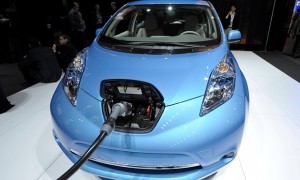
On average, 62% of vehicle miles travelled in the US are for a single person, often travelling in a much larger five-seater car. To overcome this inefficiency, the researchers suggest future autonomous vehicles will include smaller cars designed for just one, or two people, as well as larger vehicles. In the study, these hypothetical cars were based on the five-seater Nissan Leaf, but with a reduced width of 40%, accommodating a single seat.
Electric-powered cars in 2030 are expected to benefit from reduced greenhouse gas emissions as the US energy industry switches to more renewable power sources. The US Energy Information Administration projects that emissions associated with electricity generation will decrease by 8.5% by 2030. The Environmental Protection Agency proposes a decrease of 30% and finally California is aiming for a fall of 55% by 2030, fuelled by a number of state-wide policies.
All three scenarios are included in the study, with the results suggesting a driverless electricity-powered vehicle in 2030 will contribute to the release of 87-94% less greenhouse gas emissions, as compared to a conventional petrol-driven vehicle today. This range is dependent on which of the three electricity generation models turns out to be correct.
While such savings would be dramatic, their impact is dependent on autonomous taxis playing a significant role in personal transit over the next couple of decades.
Eastlake believes this will be the case, but warns against a one-size-fits-all solution.
“There’s no doubt that small lightweight electric vehicles make a lot of sense for city centres, but I think we’ll see specialised transport solutions for different scenarios,” he said. “We need a blend of technologies – electric power, biofuels and more – where the optimum will be applied to the right kind of situation.”