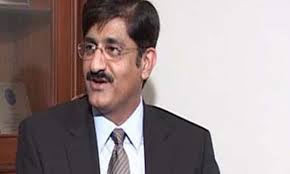
KARACHI: Sindh Chief Minister Syed Murad Ali Shah has said that the Sindh Government pursues a progressive tax policy rather than a regressive one with low tax rate as its cardinal component.
Consequently, no new tax was levied in the budget 2017-18, announced on June 5, 2017, maintaining the standard rate at 13 per cent, the lowest in any tax domain in the country, he said.


This he said while talking to Chairman SRB Khalid Mahmood who presented him SRB annual report 2016-17 here at CM House, said a statement on Thursday.
The CM Sindh said the revenue target of Rs 100 billion set for FY 2017-18 poses an enormous challenge.
He urged the SRB employees to employ all resources and put in their best efforts to achieve this target without compromising organization’s taxpayer-friendly image, espoused over the years.
The report presented him by Chairman SRB Khalid Mahmood says 2016-17 was marked by a certain salience.
The standard rate was reduced from 14 to 13 per cent, while the annual target was scaled up 28 per cent over the previous year, to Rs 78 billion.
This was a daunting challenge given that the Sindh Revenue Board (SRB) was already confronted with a shrinking revenue space owing to the year-on-year incremental revenue expansion, since its start of the operations in 2011-12.
The ports and terminal operators, telecommunication, insurance and banks remained the principal contributors. Contract execution, franchise and constructions also provided increased revenues.
Nonetheless a lot of areas remained uncharted and yet to be tapped into the system. This report acknowledges the contribution of the taxpayers in the top 10 sectors.
Nevertheless, enormous efforts are required to open up the services sector, predominately in the informal segment of the economy, to boost documentation and the tax revenue, with the past nationwide experience not serving as a guide.
The report says, SRB accords a high priority to development of human resource, to upgrade skills and intellectual talents-that grow and flourish with experience-on a continuous basis to enable employees face emerging challenges.
With that in mind, contacts were made with the international Bureau of Fiscal Documentation (IBFD), Amsterdam, and the World Bank to seek their help in organizing training during 2017-18 for the SRB employees on the best international practices concerning sales tax enforcement and audit.
A fresh batch of 40 officers was inducted to the organization following a rigorous selection process, developed and supervised in association with IBA Karachi.
During the year, SRB’s in-house training facility Sindh Institute of Fiscal Management (SIFM) became operative under the supervision of a seasoned training expert.
Besides catering to SRB’s own requirement, the facility will be available to other fiscal and revenue organizations within the province.
Over time, the facility will be upgraded to extend its services for training and research to private sector as well.
In order to provide a suitable health cover for the employees and their dependents, a health insurance scheme was also introduced during the year.
The report says that a considerable progress has been made on improving the IT-system and initiating necessary work for introduction of Point of Sales (POS) system for services involving cash transactions.
By the end of the year 2017-18 or around, POS system is likely to be in place embracing the key service in that sector.
The CM Sindh directed the SRB Chairman to lay the report before the Provincial Assembly for scrutiny, in keeping with the democratic norms. The legislators would discuss the report to further improve the SRB performance, he said.