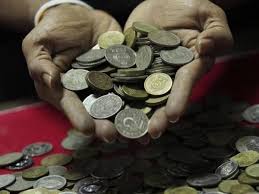
COLOMBO: Sri Lanka’s rupee is kept weak by central bank purchases of dollars, despite the ending of large scale money printing, partly backed by an ideology of using a ‘competitive exchange rate’ to boost merchandise exports, officials said.
“If the Central Bank did not buy dollars, the rupee would have appreciated,” Deputy Governor Nandalal Weerasinghe said. Sri Lanka’s rupee collapsed from Rs131 to Rs147 to the US dollar in 2015 as more than Rs300 billion of liquidity tied up in repo deals was released and more than Rs200 billion were printed outright by domestic asset acquisitions by the Central Bank. Over the past three months, the Central Bank has stopped wholesale printing of money to keep rates down and finance a budget deficit, and commercial banks have raised deposit rates steadily.


Banks are now giving loans with real deposits instead of rupee reserves or Central Bank credit (printed money) injected to the banking system through Treasury bill purchase of the monetary authority. Meanwhile, foreign investors who sold out of bonds as the rupee came under pressure from money printing in 2015 had started to come back after a deal with the International Monetary Fund ensured prudent monetary policy and tighter budgets.
“The rupee seems fairly stable,” Governor Indrajit Coomaraswamy said. “Some money has come in. But for the exchange rate to shift, it needs to be in quantities where the overall is improving significantly. “Some money has come in, but as far as I understand, it is not in quantities that is sufficient to shift the needle as far as appreciating the currency is concerned.”
Governor Coomaraswamy’s assertion runs strongly counter to the oft-repeated statements by central bankers (when money is printed to manipulate rates down and de-stabilise the rupee) that Sri Lanka’s markets forex are narrow, illiquid and the currency tends to depreciate at the slightest hiccough.
The Central Bank may have bought about $600 million over the past three months, Coomaraswamy said. “If we are to have an export derive clearly you have to maintain the competiveness of the rupee as well,” Coomaraswamy said.
Countries with loose policy, which have higher inflation than competitors, suffer even higher inflation when currencies fall. Initially, prices of exports and imports rise (trade goods), and then over time, the price structure of non-trade goods is also adjusted up. The inflation then requires more depreciation to ‘maintain competitiveness’, leading a depreciation-inflation spiral.
Export firms make profits initially from depressed real wages and lower living standards of workers. With lower real wages, exporters could win more orders for a time. In Sri Lanka, because energy and utility prices are not hiked immediately with currency depreciation export firms can also get additional temporary profits, passing on the cost to the rest of society, when energy or water utilities make losses.
However, weak exchange rates give strong incentives for firms to stay focussed on low wage, low labour productive industries. By destroying real capital and savings, currency deprecation also deprives the main tool for all enterprises to boost labour productivity. Workers may also migrate abroad to countries to countries with stronger currencies such as the Middle East, where labour productivity is higher, to meet their aspirations.
The inflation, depending on the severity and how much inflation the anchor currency also causes, leads to labour unrest and political instability as incumbent governments become unpopular, discouraging foreign direct investors. In East Asia, except Indonesia and the Philippines, which have weak currencies and export labour, most other nations have had prudent monetary policy and strong exchange rates. Many import labour.
The UK’s industrial base was destroyed after World War II amid currency instability and inflation (sterling crises), while Germany, which founded its economic management on sound money (prudent monetary policy) became an export power house with a strong Deutsche Mark.
Britain also suffered ‘brain drain’ in the 1960s and 70s, giving rise to the term amid Keynesianism tinged with socialism. After World War II, most British universities except London School of Economics – which was influenced by Friedrich von Hayek, an economist who successfully challenged John Maynard Keynes before the war – taught neo-Mercantilist policies based on unsound money.
Britain became a strong nation only after Margaret Thatcher, influenced by Hayek, came to power in the late 1970s, ending the so-called Great Inflation of the 1970s. Sri Lanka was also caught in a depreciation-inflation cycle especially in the 1980s, until prevalent ideology of macroeconomic instabiliyt and unsound money was challenged by Central Bank Governor A S Jayawardena, who had studied at LSE (Economics of A S Jayawardena), who made the first moves to break the depreciation-inflation spiral.