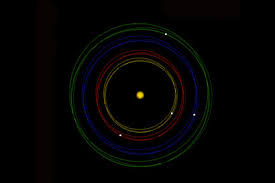
SAN FRANCISCO: Researchers at two U.S. universities have found that a four-planet system observed several years ago by the Kepler spacecraft is a rarity: the planets are orbiting the star in a unique resonance that has been locked in for billions of years.
Specifically, within the stellar system, for every three orbits of the outermost planet, the second orbits four times, the third six times and the innermost eight times, the researchers from the University of Chicago and University of California, Berkeley, said in their report online Wednesday in the journal Nature.


Such orbital resonances are not uncommon, as our own dwarf planet Pluto orbits the sun twice during the same period that Neptune completes three orbits, but a four-planet resonance is rare.
The planets are all miniature Neptunes nestled close to the star.
The researchers are interested in the system, known as Kepler-223, because our system’s four giant planets, namely Jupiter, Saturn, Neptune and Uranus, are thought to have once been in resonant orbits that were disrupted sometime during their 4.5-billion-year history.
Howard Isaacson, a UC Berkeley research astronomer and co-author of the study, said the system can help us understand how our solar system and other stellar systems discovered in the past few decades formed, and help resolve the question of whether planets stay in the same place they formed, or whether they move closer to or farther from their star over the eons.
“Basically, this system is so peculiar in the way that it’s locked into resonances that it strongly suggests that migration is the method by which the planets formed – that is, migrating inward toward the star after forming farther out,” he said.
“Exactly how and where planets form is an outstanding question in planetary science,” Sean Mills, a graduate student at the University of Chicago, was quoted as saying in a news release from UC Berkeley. “Our work essentially tests a model for planet formation for a type of planet we don’t have in our solar system.”
The resonance could have been set up within a few 100,000 years, as each planet in turn migrated close enough to the others to get captured. The astronomers suspect there were special circumstances that allowed the resonance to persist for 6 million years.
Scientists suspect that our solar system’s massive planets may have been knocked out of resonances that once resembled those of Kepler-223, possibly after interacting with numerous asteroids and small planets. Other processes, including tidal forces that flex the planets, might also cause resonance separation.
“These resonances are extremely fragile,” said co-author Daniel Fabrycky of the University of Chicago. “Many of the multi-planet systems may start out in a chain of resonances like this, fragile as it is, meaning that those chains usually break on long timescales similar to those inferred for the solar system.”