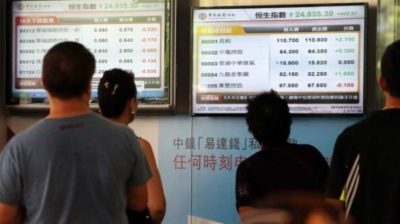
SINGAPORE: Stocks in Asia fell early Monday after major oil producers failed to reach an agreement to curtail production in Doha over the weekend.
Energy stocks in Hong Kong and Australia were all off about 2.8%, while the broader Hang Seng Index and S&P/ASX 200 benchmarks were down fractionally—by 0.9% and 0.2%.
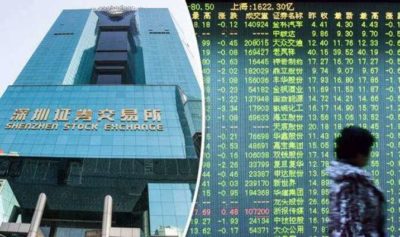

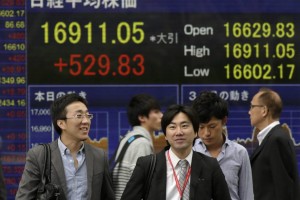
Japan’s Nikkei Stock Average was off 3%, as the Japanese yen came close to reaching a fresh 18-month high. Elsewhere, the Shanghai Composite Index slipped 1.3% and South Korea’s Kospi was off 0.5%.
Broad losses in the region came as oil prices opened sharply lower in Asian trading hours. Over the weekend, talks between oil producers collapsed when Saudi Arabia reasserted a demand that Iran also agree to cap its oil production.
“Sentiment is mainly being driven on the oil news,” said Alex Wijaya, sales trader at brokerage CMC Markets. “It is a sharp turn around as heading into the weekend, markets were confident that a deal could be made.”
Brent crude oil was last down 4% to $41.33 a barrel.
In Australia, commodity producers BHP Billiton Ltd. and Rio Tinto Ltd. were off 2.7%, 1.1%, respectively. The country’s currency was also taking a hit with the Australian dollar falling by more than 0.7% against the U.S. dollar.
In Hong Kong, the state owned oil producer PetroChina Co. Ltd. was off 2.3%.
Japan’s market, while not as heavy on commodity stocks, suffered most in the region as pressure mounted in the wake of earthquakes in the Kumamoto prefecture since last week, including on Saturday. Still, Tokyo-listed oil producer Inpex Corp. plunged 4.8%.
Auto makers like Toyota Motor Corp., Honda Motor Co. and Nissan Motor Co. were off about 4% on worries over production losses and on strength in the yen. The stronger yen makes Japanese exports less competitive and cuts into the value of repatriated earnings.
Toyota said it would halt vehicle production at most of its plants in Japan because of a shortage of components following the Kumamoto quakes. Honda and Nissan are among other auto makers that have also halted operations at factories in the area following the earthquakes.
Mr. Wijaya said the earthquake could prompt the Bank of Japan to introduce more aggressive monetary easing measures at its next meeting later this month.
Bank shares on Japan’s Topix fell 3.8%, which Mr. Wijaya attributed to worries of damages to the sector from the earthquake disaster.
Meanwhile, the Japanese yen continued its recent ascent. Treasury secretary Jack Lew said in recent days that the U.S. won’t support intervention by Japan to weaken the yen, furthering uncertainty over how Japanese authorities will handle the currency.
The Japanese yen reached 107.88 to one U.S. dollar and was last up 0.6%. Its strongest level against the dollar since October 2014 was 107.61 yen, which was reached on April 11.