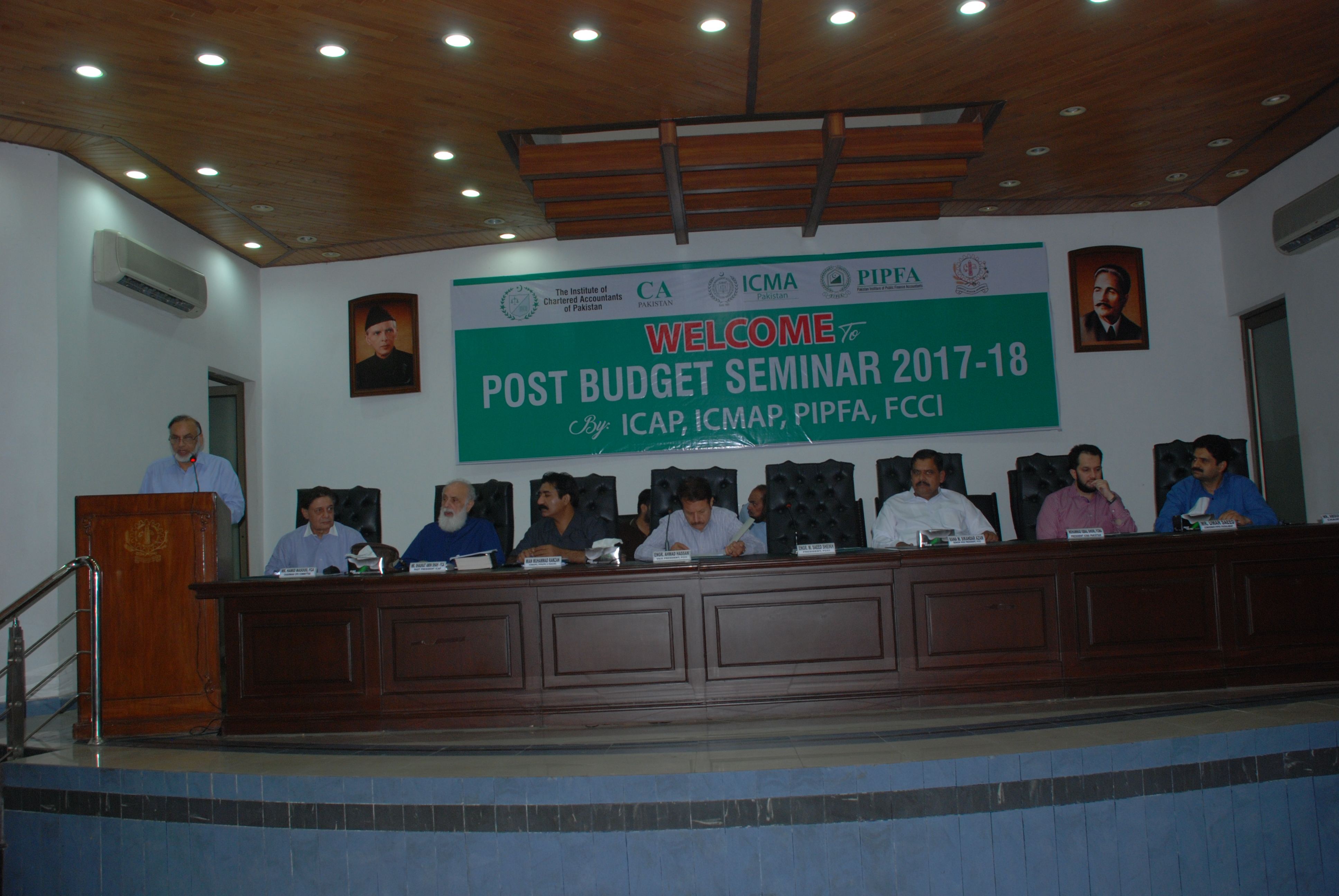
FAISALABAD. Tax professionals and business community has termed Federal Budget 2017-18 as growth-led with minor tax adjustment to offset the ill impacts o inflation and debt servicing, said Shaukat Amin Shah former President Institute of Chartered Accountants of Pakistan (ICAP).
He was addressing a post-budget seminar jointly organized by Faisalabad Chamber of Commerce and Industry (FCCI) and ICAP here.


The function was also attended by senior vice president FCCI Rana Sikandar Azam, Vice president Engineer Ahmed Hassan, Chairman CPT Committee of ICAP Hamid Masood and Mian Muhammad Ramzan.
Shaukat Amin Shah said that in budget formulation there are three main stakeholders including chambers, chartered accountants and FBR and they must be involved in this process to make the budget progressive, people friendly and result oriented. He expressed concern on the declining exports and said that exports are always exempted from taxes as we cannot export taxes. He said that no doubt government has declared 5 important export sectors as zero-rated but they have not been actually zero rated. Hence, government should implement on this decision in its true spirit so that our export products could compete in the international market.
Regarding tax related laws, he said the present tax system has inherited many discrepancies and we must review this system to make it fool proof and in according to the ground realities. He also mentioned income tax ordinance 2001 along with its different amendments. He explained in detail the negative and positive effects of these amendments on the overall business environment. He criticizes the increase in turnover tax that has been enhanced from 1% to 1.25% and said that it will have negative repercussions and hence, this increase should be withdrawn immediately. He also opposed increase in the tax on surplus profit of nonprofit organizations and said that this tax should not be more than 10%.
Regarding resource mobilization, Shaukat Amin Shah said that membership of chamber should be declared mandatory for anybody to start any new business. He also regretted over the recent incidents of harassment and said that a strict accountability system should be introduced for the tax officer so that no one could create undue harassment among the business community for his own personal motives.
Mian Muhammad Ramzan FCA also addressed the function and said that federal laws should be harmonized with the provincial sales tax laws. He also criticizes the high rate of sale tax and said that these should be curtailed to the minimum. He also demanded to clip the discretionary laws of FBR officials as these are counterproductive and are discouraging businessmen to enter into the tax net.
Earlier in his address of welcome, president FCCI Engineer Muhammad Saeed Sheikh said that government has proposed new taxes to the tune of Rs.120 billion but its impact will be more than Rs.400 billion. Hence, government should review these taxes. He appreciated the continuity of the zero rating and said that textile package of Rs.180 billion will also help to drag out textile sector from protracted crisis. He appreciated the steps taken by the government to provide electricity and gas round the clock to the industrial units. He said that the growth rate of GDP has been fixed at 6% which is ambitious but achievable provided the agriculture and industrial sector responded positively. He also mentioned the sick industrial units and said that the private sector has invested billion of rupees on these units that have either been closed down or working with hardly 30 to 40% of their installed capacity. He also repeated the demand for the immediate payment of all refund, rebate and sales tax claims. He further said that government should enhance the tax base instead of adding burden on the existing tax payers.
He also demanded that the tax system should be uniform and every person should contribute its due shares in national kitty without any privilege or exemption. He said that government should pay due consideration to the recommendations of the ICAP to make the federal budget acceptable to the majority of people.